On this page
Bhastrika is one of the two strongest practices in the library, and the one people most often confuse with the other. The distinction is simple and worth getting right before you start: in Bhastrika both the inhale and the exhale are forceful, where in Kapal Bhati only the exhale is active and the inhale falls in by itself.
What it is
The practice is a rhythm of full, forceful breaths, equally strong in both directions, like a blacksmith working a bellows. The belly and chest expand and empty completely on each breath. It is run in short timed rounds with a complete rest between them.
Because both halves are active, Bhastrika moves considerably more air than Kapal Bhati at the same tempo, and it is the more demanding of the two on the chest and the cardiovascular system. It is warming and stimulating, and the tradition uses it to build heat and energy.
What people commonly report is warmth, alertness, and a slightly buzzing clarity afterwards. It is not a practice with a subtle effect, and the strength of the effect is the reason for the conservative dosing rather than despite it.
The cautions here are not boilerplate. This practice is genuinely contraindicated for a list of conditions, including any respiratory condition such as asthma, and those are set out in full below.
How to practise it
-
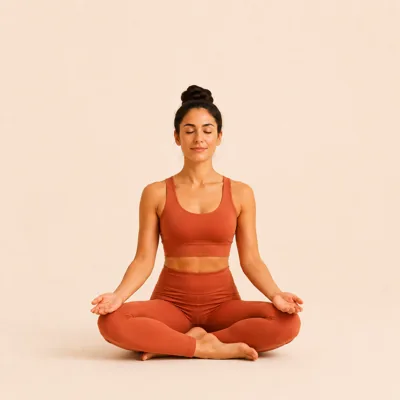
Sit tall
Sit tall and comfortable with the spine upright and the chest open, on an empty stomach. Keep the shoulders and face relaxed.
-
The bellows
Inhale fully and forcefully through the nose, then exhale with equal force, in a steady rhythm. Like a blacksmith's bellows. The belly and chest expand and empty fully with each breath.
-
Pace and dose
Start slower and gentler than you think you need. This practice gives three short timed rounds with full rests between; if a round feels like too much, stop early and breathe naturally.
-
Rest and observe
Between rounds, let the breath return completely to normal and feel the warmth and alertness the practice generates.
How long and how often
The app runs three short timed rounds with full rests between. That is the whole session, and it is deliberately small.
The instruction that matters most is to start slower and gentler than you think you need. The pace, not the number of breaths, is what makes this practice too much too quickly, and a slow forceful breath is still a forceful breath.
The rests are part of the practice rather than a gap in it. Between rounds the breath returns completely to normal before the next one starts. If a round feels like too much, stop it early and simply breathe. That is a correct response, not a failed round.
Practise on an empty stomach, sitting tall, with the shoulders and face relaxed. Morning suits it. Late evening does not.
What usually goes wrong
Going fast. Speed is what turns this into a problem. A steady, moderate rhythm with full breaths is the practice; a rapid one is hyperventilation with a Sanskrit name. Start slow and stay there for weeks.
Tensing the face and shoulders. The force comes from the trunk. If the shoulders are rising and the jaw is set, you are recruiting the wrong muscles and will tire within a round.
Skipping or shortening the rests. Running the rounds together is the fastest way to become dizzy. The breath should be fully normal again before the next round begins.
Pushing past dizziness. Dizzy, faint or breathless means stop, immediately and completely. This is not a practice where those sensations are a stage you work through.
Who should take care
Practise safely. Practise on an empty stomach with the shoulders and face relaxed. Stop at once if you feel dizzy, faint, or breathless. Avoid this practice if you are pregnant, or have high blood pressure, heart disease, epilepsy, a hernia, recent surgery, or any respiratory condition such as asthma. When in doubt, choose a gentler breath and consult a qualified teacher or doctor. See our full Health & Safety Disclaimer.
Three rounds, timed, with the rests built in
The rests between rounds are the part people cut short, and they are what keeps this practice safe. PanchPrana times all three rounds and the full rests between them. Bhastrika is one of the 66 techniques that are free to practise in full, with no account needed.


Common questions
What is the difference between Bhastrika and Kapal Bhati?
In Bhastrika both the inhale and the exhale are forceful and full. In Kapal Bhati only the exhale is active, driven by a sharp contraction of the lower belly, and the inhale is passive. Bhastrika moves more air and is the more demanding of the two.
How fast should the breaths be?
Slower than you expect. A steady rhythm you could hold comfortably for the whole round is right. Speed is the variable that causes trouble here, not duration.
Who should avoid it?
The app is explicit: avoid Bhastrika if you are pregnant, or have high blood pressure, heart disease, epilepsy, a hernia, recent surgery, or any respiratory condition such as asthma. The respiratory exclusion is worth noting because it is broader than for most practices.
Can I do it in the evening?
It is warming and stimulating, so it suits the morning far better. Practising it late tends to work against winding down.
What if I feel dizzy?
Stop at once and breathe naturally until it passes. Then practise fewer, slower breaths next time, or choose a gentler technique.