On this page
Chandra Bhedan reverses Surya Bhedan exactly. Every inhale comes through the left nostril and every exhale leaves through the right, and the intent is cooling and quiet rather than warmth and alertness. The two practices are best learned as a pair, because knowing one tells you the other and knowing when to choose between them is most of the skill.
What it is
The name means moon-piercing. In the tradition the left nostril is associated with cooling, receptivity and quiet, and drawing every breath in through it is understood to emphasise those qualities. The right carries the warming associations, which is why solar breath fixes the inhale there instead.
The mechanics are those of Nadi Shodhan with the alternation removed. Using Vishnu Mudra with the right hand, close the right nostril and inhale slowly through the left, then close the left and exhale through the right. That is one round, repeated.
The app adds one refinement that solar breath does not have: a slightly longer exhale deepens the calm. That is consistent with everything else in the calming family, where a weighted out-breath is the common thread, and it is optional rather than required.
What can honestly be said is that the directional associations are longstanding and consistent within the tradition, and that people commonly report this practice settling them in the evening. Whether nostril dominance produces the effects described is a claim that would need clinical evidence and is not made here.
How to practise it
-
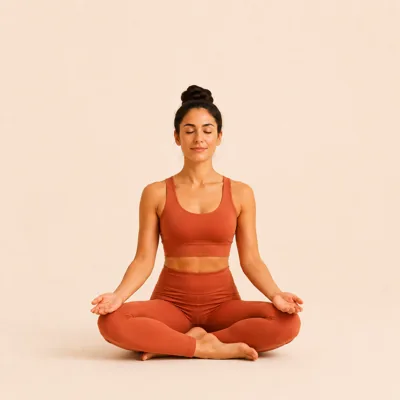
Sit comfortably
Settle into a comfortable seated posture with a tall, easy spine, and let the shoulders and face soften.
-
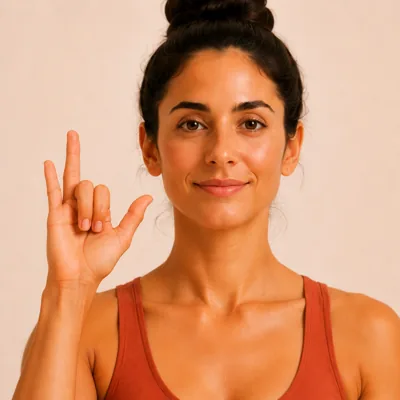
The hand position (Vishnu Mudra)
Use the right hand: fold the index and middle fingers towards the palm, so the thumb closes the right nostril and the ring finger closes the left.
-
Left in, right out
Close the right nostril and inhale slowly through the left. Then close the left and exhale through the right. A slightly longer exhale deepens the calm. That is one round.
How long and how often
The app runs ten rounds, three or four minutes at a slow pace. That is a complete session and there is no progression to work through.
Keep the breath gentle and quiet throughout. There is no retention here. If you want the longer exhale, let it be modest: six out against four in is plenty, and the practice does not need it to work.
Evening is where it belongs, and before rest or sleep in particular. Avoid it when you feel cold, congested, or low in energy, which is precisely when solar breath is the better choice.
What usually goes wrong
Reaching for it when you are cold or flat. This is a cooling, quietening practice. Used when already low it tends to flatten further. The app is direct about this: choose the warming solar breath instead.
Swapping the direction by accident. The inhale is always left. If the sides start alternating you have drifted into Nadi Shodhan, which balances rather than cools.
Pressing hard on the nostril. The finger closes the nostril softly. There is no need to push, and pressing distorts the nose and tightens the face.
Making the exhale much longer. A slightly longer out-breath deepens the calm. A dramatically longer one makes the following inhale arrive in a rush, which undoes it.
Who should take care
Practise safely. Lovely before rest or sleep. Avoid if you are feeling cold, congested, or low in energy, when the warming Solar Breath suits better. Keep the breath gentle and stop if you feel lightheaded. See our full Health & Safety Disclaimer.
Ten rounds before you wind down
PanchPrana teaches the Vishnu Mudra hand position first and then counts the rounds, so the only thing to track is which nostril is open. Lunar breath is one of the 66 techniques that are free to practise in full, with no account needed.


Common questions
Which nostril do I inhale through?
The left, every time, exhaling through the right. The direction never swaps, which is what separates it from alternate nostril breathing.
When should I practise it?
In the evening, before rest, or to cool a heated mind. Avoid it when you feel cold, congested or low in energy.
How is it different from solar breath?
It is the exact mirror. Solar breath inhales right and exhales left and is warming; lunar breath inhales left and exhales right and is cooling.
Should the exhale be longer than the inhale?
Slightly longer deepens the calm and is what the app suggests. Keep it modest, and drop it if the next inhale starts arriving in a rush.
Can I use it to get to sleep?
Many people find it suits the wind-down before bed. It is a support rather than a treatment, and persistent sleep problems are worth raising with a doctor.