On this page
Strip the holds, the sounds and the hand positions out of the calming breathing practices and what remains is this: breathe out for longer than you breathe in. Extended exhale is that instruction on its own, with nothing added. It is the least interesting practice in the library and the one most worth building a daily habit on.
What it is
The rhythm is an inhale of four and an exhale of six, both through the nose, both smooth. There is no pause at either end and no retention anywhere. If six feels long, four and five is a legitimate starting point.
The usual explanation is that heart rate tends to settle slightly on the out-breath and lift on the in-breath, so weighting the cycle toward the exhale tips the balance toward settling. That is the standard account of why the practice is shaped this way, and it is a reasonable frame.
What can be said plainly is that people commonly feel calmer after a few minutes of slow, extended-exhale breathing, that this is easy to test on yourself, and that it is the main reason the practice has stayed in use for as long as it has. Any claim that it treats an anxiety disorder is a different order of statement and is not made here.
The practical case for it over the more elaborate techniques is that it scales. Four rounds of 4-7-8 is a session and twenty would be a mistake. Extended exhale can be done for ten or fifteen minutes without any concern, which makes it the one to reach for when the aim is a regular practice rather than a reset.
How to practise it
-
Sit comfortably
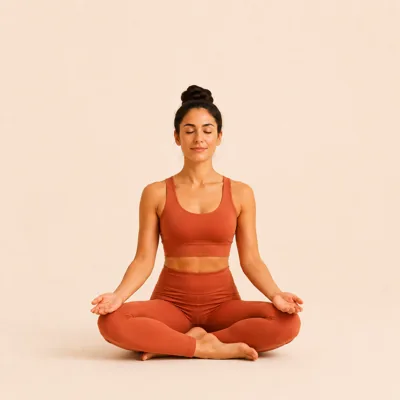
Choose any steady seated posture. Cross-legged on the floor, or feet flat on the floor in a chair. Let the shoulders soften and the spine rise gently tall.
-
The rhythm
Inhale through the nose for a count of four, then exhale slowly for a count of six. If six feels long, start with four-in and five-out and build up over days.
-
Keep it easy
Let the exhale be soft and complete, without squeezing the last of the air out. The inhale should arrive naturally after each exhale, never gasped.
How long and how often
The app runs fourteen rounds, which comes to roughly three minutes at four-in and six-out. That is a good daily dose and a sensible session length to start with.
The progression holds the inhale steady and lengthens only the exhale. Keep the inhale at four throughout. Start with an exhale of six, move toward eight over a fortnight, and go to ten only if the breath is still smooth at eight. Add rounds alongside so the session lengthens as well.
The rule that keeps this safe is the gasp test. If the inhale after a long exhale arrives in a rush rather than easily, the exhale was too long. Drop back a count and stay there for a few more days. Nobody has been harmed by spending an extra week at four and six.
It suits daily practice on ordinary days more than it suits emergencies. The point of practising when you are already calm is that the pattern is then available when you are not.
What usually goes wrong
Squeezing the lungs empty. A long exhale is not a hard exhale. Forcing the last of the air out recruits the abdominal and intercostal muscles you were trying to release, and it guarantees the next inhale is sharp. Let the exhale be slow and complete without pressing.
Pulling the inhale in. The inhale should arrive by itself once the exhale has finished. If you are actively drawing it in, the exhale has gone on too long or emptied too far.
Jumping to a long count. Four and ten sounds more serious than four and six and is worse if you cannot hold it smoothly. The right ratio is the longest one where the following breath still arrives easily.
Monitoring whether it is working. Checking on your own calm keeps a part of you alert. Set the rhythm, run the rounds, and assess afterwards rather than throughout.
Who should take care
Practise safely. Breathe through the nose throughout and keep every breath quiet. If you feel short of breath or lightheaded, return to your natural breath. Gentle and consistent is the aim. See our full Health & Safety Disclaimer.
A fourteen-day build, on a schedule
PanchPrana cues each phase aloud so you can close your eyes and follow, and its Calm and Anxiety Relief course lengthens the exhale one day at a time rather than leaving it to how ambitious you feel that morning. The technique itself is one of the 66 that are free to practise in full.


Common questions
What ratio should I aim for?
An exhale roughly one and a half to two times the inhale. Four in and six out is a good start; four in and eight out is a reasonable place to arrive after a few weeks. Longer is not automatically better.
Nose or mouth for the exhale?
Nose for both, in this practice. Pursed-lip breathing and 4-7-8 use the mouth on the way out because the narrowed lips or the whoosh are doing part of the work; here nothing needs to.
How long before I notice anything?
Most people feel some settling within a few minutes of a session. The larger benefit, having the calmer pattern available when you need it, comes from practising on ordinary days over weeks rather than from any one sitting.
Is this the same as coherent breathing?
No. Coherent breathing keeps the inhale and exhale equal and fixes the rate at about five or six breaths a minute. Extended exhale deliberately makes the two unequal and does not care about the rate.
Can I do it lying down or walking?
Both. Lying down suits it at night. Walking works once the rhythm is reliable, matching the counts to your steps. Sitting is the easiest place to learn it.