On this page
Most calming practices ask you to lengthen the exhale on purpose, which is difficult precisely when you most need it, because a tight chest does not want to cooperate with a count. Pursed-lip breathing sidesteps that. Narrowing the lips slows the air on the way out mechanically, so the long exhale happens whether or not you are concentrating.
What it is
The pattern is a gentle inhale through the nose for about two counts, then an exhale for about four through pursed lips, as though you were about to whistle or blow out a candle slowly. The exhale is roughly twice the inhale, and the lips are doing most of the work of making it so.
This is the practice most widely taught outside yoga. It is a standard part of breathing advice for breathlessness, and the reason is the mechanism rather than the tradition: exhaling against a slight resistance keeps a little back-pressure in the airways, which holds them open marginally longer and lets more air out per breath.
What people commonly report is that it eases the feeling of not being able to get a full breath, and that it is easier to do while flustered than any counted practice. It is a supportive technique rather than a treatment; if breathlessness is new, persistent, or worsening, that is a matter for a doctor rather than a breathing exercise.
How to practise it
-
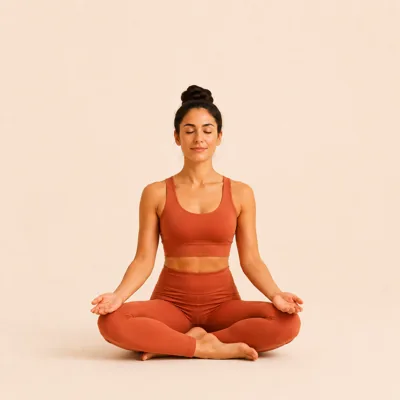
Sit comfortably
Sit comfortably with the shoulders, neck, and jaw soft. You can do this seated in a chair or cross-legged. Wherever the upper body can relax.
-
Inhale through the nose
Inhale gently through the nose for about two counts, keeping the shoulders relaxed.
-
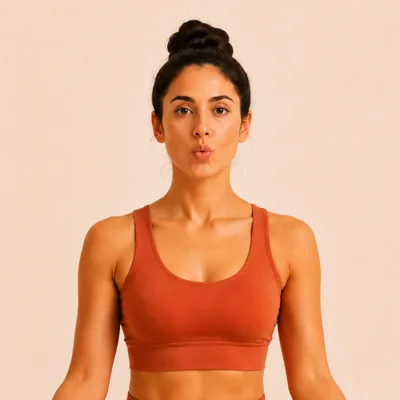
Exhale through pursed lips
Purse your lips as if you were about to whistle or gently blow out a candle, and exhale slowly for about four counts. Roughly twice as long as the inhale.
-
Keep it easy
Let the exhale be slow and unforced; there is no need to empty the lungs completely. Repeat until the breath feels calmer and easier.
How long and how often
The app runs ten rounds, which is two or three minutes. Repeat until the breath feels easier rather than until a number is reached, which is how it is usually taught elsewhere too.
There is no progression to climb. The counts of two and four are approximate and the ratio is the only thing worth keeping. If two feels short, three and six is the same practice.
It suits any moment where the breath feels tight or quick, including during light exertion such as climbing stairs. It is also a good bridge: one or two physiological sighs to take the edge off, then a minute of this, then extended exhale once things have loosened.
What usually goes wrong
Blowing hard. The resistance comes from the shape of the lips, not from force behind the breath. Blowing forcefully defeats it and tires you out. The candle you are imagining should flicker rather than go out.
Emptying the lungs completely. There is no need to push out the last of the air, and doing so tightens the very muscles the practice is trying to settle.
Pursing the lips too tightly. A small opening is enough. Clamping down turns a gentle resistance into a struggle and brings the shoulders into it.
Taking a big inhale to prepare. The inhale here is deliberately short and gentle. A large one puts you back into the upper chest, which is where the tightness came from.
Who should take care
Practise safely. This is a gentle breath that is safe to use any time you feel short of breath or anxious. Never force the exhale. If you feel lightheaded, return to your natural breath. See our full Health & Safety Disclaimer.
Ten rounds, paced for you
PanchPrana cues the two-count inhale and four-count exhale so the rhythm is held for you at exactly the moment concentrating is hardest. Pursed-lip breathing is one of the 66 techniques that are free to practise in full, with no account needed.


Common questions
Is pursed-lip breathing safe for everyone?
It is one of the gentler practices, with no retention and no forceful movement, and the app notes it is safe to use any time you feel short of breath or anxious. That said, new or worsening breathlessness should be assessed by a doctor rather than managed with a technique.
How is it different from extended exhale?
The ratio is similar; the mechanism is not. Extended exhale asks you to lengthen the out-breath deliberately and count it. Here the pursed lips slow the air for you, so it works when you have no attention to spare.
Can I use it while walking or climbing stairs?
Yes, and it is commonly taught that way for exactly that situation. Match the exhale to a few steps rather than to a count.
Do the counts of two and four matter?
Only as a proportion. Three and six or four and eight are the same practice. What matters is that the exhale is roughly twice the inhale and stays unforced.
Should the lips be tight?
No. A small, relaxed opening, the shape you would use to blow out a candle gently. Tight lips add effort without adding benefit.