On this page
Almost every breathing practice needs a few minutes and somewhere to sit. This one needs about ten seconds and works standing up with your eyes open. That makes it the practice to have available for the moment something has just happened, which is precisely when nobody is going to sit down and count to four.
What it is
A physiological sigh is a double inhale followed by a long exhale. You breathe in through the nose, then without breathing out you take a second shorter sniff on top to fill the rest of the way, and then let all the air out slowly through the mouth, longer than the inhale was.
The shape is not invented. It is what a spontaneous sigh already looks like, and what happens by itself when someone has been crying. The practice is a deliberate version of a reflex the body performs unprompted.
The usual explanation is that the second inhale reinflates parts of the lungs that have collapsed slightly, and that the long exhale offloads carbon dioxide and lets the heart rate settle. That is the standard account. What people commonly report is that one or two rounds take the edge off within seconds, which is unusually fast for a breathing practice and is the main reason it is worth knowing. Stronger claims would need clinical evidence and are not made here.
How to practise it
-
Get comfortable
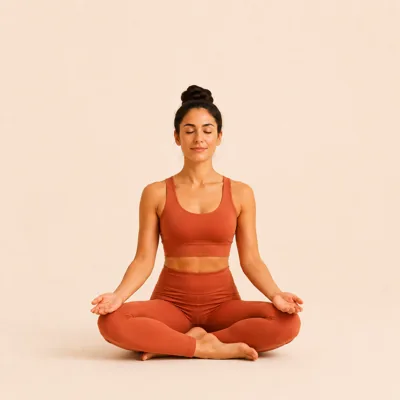
Sit or stand comfortably and let the shoulders drop. This one works anywhere. Eyes open or closed, wherever you happen to be.
-
The double inhale
Inhale through the nose, then, without exhaling, take a second short sniff to top the lungs right up. You will feel the chest expand fully.
-
The long exhale
Let all the air out slowly through the mouth, longer than the inhale. This is the part that does the calming. Unhurried and complete.
How long and how often
The app runs two rounds. One to five is the usable range, and most of the time one or two is enough. This is a reset rather than a session.
There is nothing to build. Doing twenty in a row does not deepen the effect and will usually make you lightheaded, because you are moving a lot of air quickly. If you want something longer, follow it with a minute of pursed-lip breathing or extended exhale.
It works anywhere, in any posture, at any time of day, with no empty stomach required and nothing to set up. That portability is the whole point of it.
What usually goes wrong
Exhaling between the two inhales. The second sniff goes on top of the first with no breath out in between. If you exhale first you have done two ordinary breaths, which is not the same thing.
Making the second inhale as big as the first. It is a short top-up, not a second full breath. The lungs are already most of the way full; the sniff adds the last part.
Rushing the exhale. The long slow exhale is the part that does the settling. If the out-breath is as quick as the in-breath, you have hyperventilated slightly rather than calmed down.
Stacking too many. Five is the sensible upper limit in one go. Lightheadedness here means stop, not push on.
Who should take care
Practise safely. Use it any time, eyes open or closed, seated or standing. One or two rounds is often enough. If you feel lightheaded, return to normal breathing. See our full Health & Safety Disclaimer.
Two rounds, whenever you need them
PanchPrana runs the physiological sigh as a short guided practice with the double inhale and the long exhale cued, which is the easiest way to learn the timing before you start using it unprompted. It is one of the 66 techniques that are free to practise in full.


Common questions
How many should I do?
One to five. Two is the app default and often enough. This is not a practice where more rounds do more good.
Does the exhale have to be through the mouth?
Through the mouth is easier to make long and slow, and it is how the app teaches it. Through the nose works too if you would rather be discreet about it.
Can I use it in the middle of a conversation?
Yes, and that is much of its value. It works standing, eyes open, without any visible setup. It is the only practice on this list you can run without anyone noticing.
Is this the same as just sighing?
It is the deliberate version of the same pattern. The difference is that a spontaneous sigh happens to you and this one is something you choose to do when you want it.
Why do I feel lightheaded after several?
Because a double inhale moves a lot of air, and repeating it quickly amounts to mild hyperventilation. Do fewer, and return to natural breathing until it passes.