On this page
The ankle is the joint that carries every standing posture and gets the least deliberate attention. It also stiffens quickly from sitting, which is when the feet spend hours held at one angle with very little circulation reaching them. Pointing and flexing is the simplest available remedy.
What it is
You sit with the legs extended, or stand with a hand on support and one foot slightly lifted. Point the toes away to stretch the top of the foot and ankle, then flex the foot back, drawing the toes toward you. Move smoothly between the two for five rounds, then change feet.
The two directions cover the main range of the joint. Pointing works the front of the ankle and the top of the foot; flexing works the calf and the back of the ankle. Together they take the joint through most of what it does.
The practical case is circulation after sitting, which is what the guide emphasises, and preparation for standing work. Tree Pose, Warrior 3 and anything else on one leg depends on the ankle making constant small adjustments, and a stiff cold ankle does that badly.
How to practise it
-
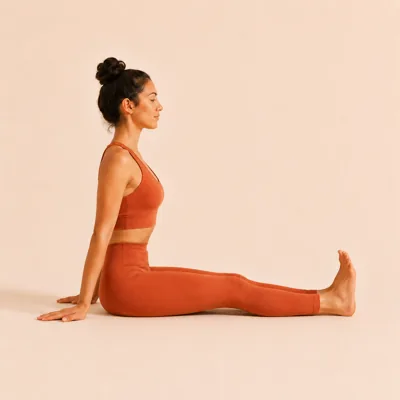
Starting Position
Sit with legs extended in front of you, or stand and rest a hand on support and lift one foot slightly off the floor.
-
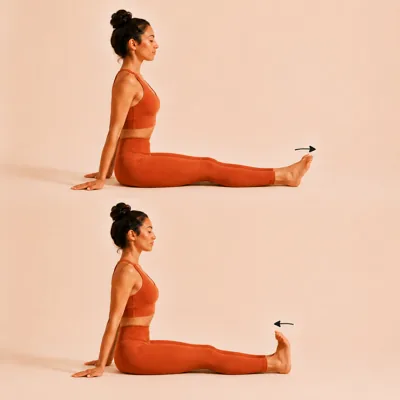
Point and flex
Point the toes away from you to stretch the top of the foot and ankle, then flex the foot back, drawing the toes towards you. Move smoothly between the two for five rounds, then change feet.
How long and how often
Five rounds on each foot, which is a minute or two for both. Work each foot evenly, which is easy to forget once the first one starts feeling better.
It suits any break from sitting and the start of a standing practice. It can be done at a desk without anyone noticing.
There is no progression here.
What usually goes wrong
Doing one foot more than the other. The first ankle often feels better than the second and the temptation is to keep going on it. Five rounds each, evenly.
Pointing hard. Forceful pointing is a common cause of cramp in the arch or calf. Move to the end of the comfortable range and no further.
Rushing the movement. Fast flapping of the foot does very little. Slow and smooth between the two positions is what moves the joint.
Ignoring a pinch at the front of the ankle. Something catching at the front when pointing means ease off. It is not a range to push into.
Who should take care
Practise safely. Keep the movement slow and gentle. Work each foot evenly, and ease off if there is any pinch or cramp in the ankle or foot. See our full Health & Safety Disclaimer.
Five rounds each foot, counted
PanchPrana counts the rounds and prompts the change of feet, which is the part most people skip. Ankle mobility is one of the 66 techniques that are free to practise in full, with no account needed.


Common questions
Seated or standing?
Either. Seated with the legs extended is easiest. Standing with a hand on a wall or chair and one foot lifted works if you would rather not sit down.
Why does my foot cramp when I point?
Usually because the point is too forceful or the foot is cold. Reduce the range, slow it down, and flex the foot back if a cramp starts.
How does this help balance poses?
Standing on one leg requires constant small corrections at the ankle. A joint that has been moved and warmed does that more readily than one that has been still for hours.
How many rounds?
Five on each foot. Evenly is the part that matters more than the number.
Can I do it at a desk?
Yes, and it is one of the better practices for that. It is invisible and takes under two minutes.