On this page
Knee circles are the most conservative movement in the library, and the guidance around them is correspondingly blunt: keep the circles small, keep them slow, never force them, and skip the practice entirely or go very gently if you have any knee pain or injury. The knee tolerates rotation poorly, which is why the movement is deliberately modest.
What it is
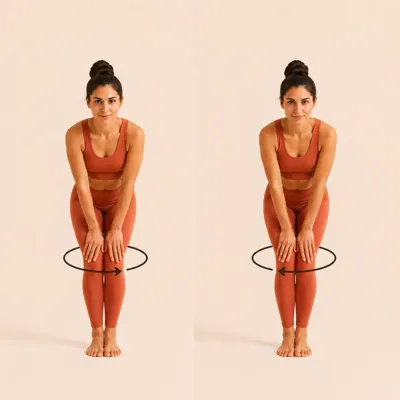
You stand with the feet together, bend the knees slightly, rest the hands lightly just above them for support, and draw small slow circles. Half a minute clockwise, half a minute the other way.
The purpose is circulation and gentle warming before standing postures rather than any increase in range. The knee is a hinge with a small amount of rotation available, and the circles are working within that small amount rather than trying to expand it.
The hands resting above the knees are there for support and to keep the movement controlled, not to press the knees into a larger circle. That distinction is the whole safety margin of the practice.
How to practise it
-
Bend and support
Stand with the feet together and bend the knees slightly. Rest your hands lightly on the knees for support and keep the back long.
-
Circle clockwise
Draw slow, small circles with the knees in a clockwise direction for half a minute, keeping the movement smooth and gentle.
-
Circle counterclockwise
Reverse and circle the knees counterclockwise for half a minute at the same easy pace.
How long and how often
Half a minute each direction, so a one-minute practice. It belongs at the start of a session that includes standing postures, particularly Chair Pose, Warrior poses or a sun salutation.
There is no progression and the circles never need to get bigger.
If the knees are painful or you have an injury, the app says to skip it or go very gently. That is worth following rather than adapting.
What usually goes wrong
Making the circles big. Larger circles mean more rotation at a joint that does not want much. Small is not a beginner setting here; it is the practice.
Pressing down with the hands. The hands rest lightly for support. Using them to push the knees around is exactly the forcing the guide warns against.
Straightening into a lock. The knees stay softly bent throughout. Circling through a locked knee puts the load in the wrong place.
Working through pain. Sharp pain in a knee is a stop signal without exception, and this is the movement where that matters most.
Who should take care
Practise safely. Keep the circles small and slow, and never force the knees. Skip or go very gently if you have any knee pain or injury. See our full Health & Safety Disclaimer.
One careful minute
PanchPrana times both directions and keeps the pace slow, which is most of what this movement needs. Knee circles are one of the 66 techniques that are free to practise in full, with no account needed.


Common questions
How small should the circles be?
Small. A few centimetres of travel is enough. The knee has limited rotation available and this practice works within it rather than trying to extend it.
Should I skip it if my knees hurt?
The app says to skip it or go very gently if you have any knee pain or injury, and that is sound. There is no part of this practice worth pushing through pain for.
What is it preparing me for?
Standing postures. Chair Pose, the Warriors, Tree Pose and sun salutations all load the knees, and a warm joint tolerates that better than a cold one.
Can I do it seated?
The standing version with the hands supporting the knees is what the app teaches. Seated variations exist but are a different movement.
Both directions?
Yes, half a minute each. It costs nothing and the two directions do not feel the same.