On this page
Almost every breathing practice in the library asks you to sit cross-legged or upright for several minutes, and how comfortable that is depends largely on the hips. Tight hips push the pelvis back, round the lower spine, and turn a settling practice into an endurance test. A minute of hip circles beforehand changes that more than most people expect.
What it is
You stand with the feet about hip-width apart, knees soft, hands resting on the hips, and draw slow wide circles with the pelvis. Half a minute clockwise, then half a minute the other way.
The movement is at the hip joints and through the lower back, and it covers a range that sitting removes entirely. The upper body stays relatively still, which is what keeps the movement in the pelvis rather than turning it into a whole-body sway.
Doing both directions matters. They are not the same movement mirrored, in the sense that most people find one direction noticeably smoother than the other, and the rougher direction is usually the one worth spending the time on.
How to practise it
-
Hands on hips
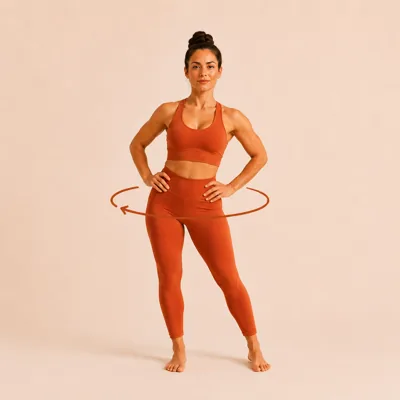
Stand with the feet about hip-width apart and the knees soft. Rest your hands on your hips and let the upper body stay relaxed.
-
Circle clockwise
Draw slow, wide circles with the hips in a clockwise direction for half a minute, keeping the movement smooth and the upper body steady.
-
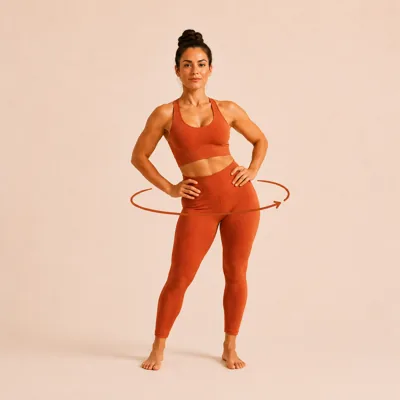
Circle counterclockwise
Reverse and circle the hips counterclockwise for half a minute, keeping the same slow, easy pace.
How long and how often
Half a minute in each direction, which is a one-minute practice. It suits the start of a movement session and the minute before sitting down for seated breathing.
Make the circles smaller if the lower back or hips feel tight. A small smooth circle is worth more than a large ragged one.
There is no progression. The circles do not need to get bigger over time.
What usually goes wrong
Swaying the whole body. If the shoulders are travelling as much as the hips, the movement has moved upward and the pelvis is along for the ride. Keep the upper body steady and let the hips do it.
Going fast. Quick circling becomes a wiggle and stops mobilising anything. Slow enough to feel the whole path of the circle is the pace.
Locking the knees. Soft knees let the pelvis move. Straight locked legs restrict the circle and put the movement into the lower back instead.
Only doing the easy direction. The direction that feels rougher is the one that needed doing. Give both a full half minute.
Who should take care
Practise safely. Keep the circles gentle and within a comfortable range. Make them smaller if the lower back or hips feel tight, and stop if you feel any sharp pain. See our full Health & Safety Disclaimer.
One minute, before you sit
PanchPrana times both directions so neither gets short-changed, and hip circles sit naturally at the start of any seated practice. It is one of the 66 techniques that are free to practise in full, with no account needed.


Common questions
How big should the circles be?
Wide but comfortable. Make them smaller if the lower back or hips feel tight; a small smooth circle is better than a large one you are forcing.
Why both directions?
Most people find one direction distinctly smoother than the other, which is exactly why the rougher one is worth the time. Half a minute each way.
Should I feel it in my lower back?
A sense of movement there is normal and part of the point. Sharp pain is not, and is a reason to stop.
Can I do it seated?
The app teaches it standing, which lets the pelvis move most freely. A seated version is possible but covers much less range.
Will it help with sitting cross-legged?
Often, yes. Tight hips are the usual reason a cross-legged seat is uncomfortable, and loosening them beforehand is the cheapest improvement available. Butterfly pose does more over time.