On this page
Butterfly is the pose most often ruined by effort. Sitting with the soles of the feet together and letting the knees fall open toward the floor is a shape gravity does for you over a couple of minutes, and pressing the knees down turns a passive opening into a forced one that the hips resist.
What it is
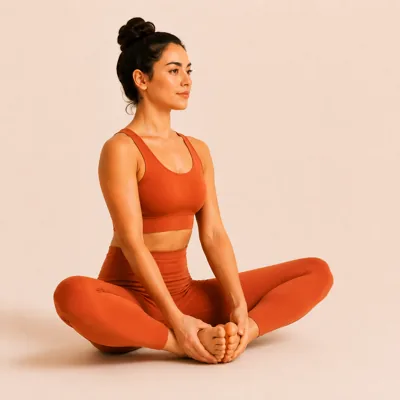
You sit tall, bring the soles of the feet together, and let the knees fall open to the sides, holding the feet or ankles with the spine gently long. You can hold it still or flap the knees up and down gently. Then release and extend the legs.
The target is the inner thighs and the hips, and the mechanism is time rather than force. Gravity is already asking the knees toward the floor. What you are doing is staying in the shape long enough, and relaxed enough, for that to have an effect.
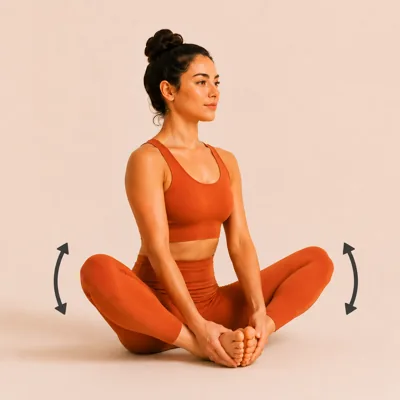
The flapping variation adds gentle movement to the same shape, which some people find more comfortable than a still hold, particularly early on. Both are legitimate versions and the app teaches both.
It is a useful counterpart to hip circles. The circles warm the joint quickly before practice; Butterfly is the one that changes how comfortable a cross-legged seat is over weeks.
How to practise it
-
Find your seat
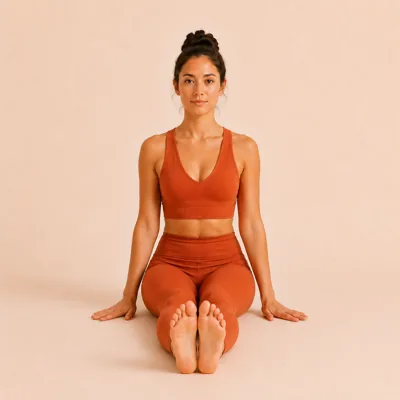
Sit tall on the floor with legs extended
-
Soles together
Bring the soles of the feet together and let the knees fall open to the sides. Hold the feet or ankles and let the spine rise gently tall.
-
Flap the knees
Gently flap your knees up and down like butterfly wings while breathing naturally.
-
Release and relax
Stop flapping, release the pose and extend your legs to come back to seated posture
How long and how often
A couple of minutes is the app suggestion, held gently. That is long enough for the shape to do something and short enough that you will not be tempted to fidget it into a stretch.
Sit up on a cushion if the lower back rounds. A rounded lower back means the pelvis has tipped backward and the pose is mostly happening in the spine rather than the hips, and a cushion under the sitting bones fixes it directly.
Support the knees with cushions if that feels better. This is not a lesser version. Knees that are supported relax; knees hanging unsupported at the end of their range often do not.
What usually goes wrong
Pressing the knees down. The single instruction the app repeats: never force the knees down. Pressing them with the hands or the elbows produces resistance in the hip rather than release, and it puts strain across the knee joint.
Rounding the lower back. If the back rounds, the pelvis is tipped back and the hips are barely being addressed. Sit up on a cushion and the shape changes completely.
Pulling the feet in too close. Heels very close to the body makes the shape much stronger. Letting the feet sit further forward is a legitimate and often more useful version.
Working through knee pain. Strain in the knees rather than the inner thighs means the position needs changing, usually with support under the knees or the feet further away.
Who should take care
Practise safely. Never force the knees down. Let them open at their own pace, and support them with cushions if that feels better. Sit up on a cushion if the lower back rounds. Ease off if you feel any strain in the knees or hips. See our full Health & Safety Disclaimer.
Two quiet minutes
PanchPrana times the hold so you are not deciding when to come out, which is when the temptation to push arrives. Butterfly is one of the 66 techniques that are free to practise in full, with no account needed.


Common questions
Should I push my knees toward the floor?
No. The app is explicit about this. Let them open at their own pace and use cushions under them if that is more comfortable.
Why does my lower back round?
Usually tight hips tipping the pelvis backward. Sitting up on a folded blanket or cushion raises the hips above the knees and lets the spine lengthen.
Should I hold still or flap?
Either. The app teaches both. Flapping suits people who find a still hold uncomfortable; a still hold suits a longer, quieter version.
How long should I stay?
A couple of minutes is a good hold. Longer is fine if it stays comfortable and nothing is being forced.
Will it help me sit cross-legged?
Over time, often yes. Tight hips are the usual reason a cross-legged seat is uncomfortable, and this is the pose that addresses them directly rather than briefly warming them.