On this page
Almost every breathing practice in this library begins with the instruction to find a comfortable seated posture, and most people take that as a formality. It is not. A seat that quietly costs you effort competes for the attention the practice needs, and the single adjustment that fixes it for most people takes a folded blanket.
What it is
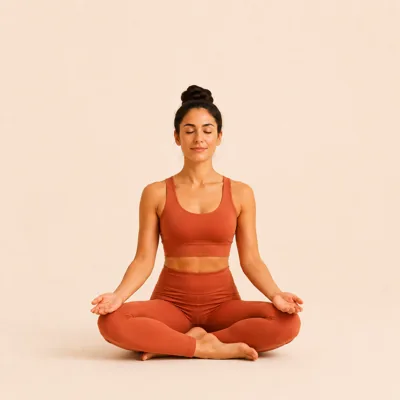
Sukhasana is a simple cross-legged seat with the knees settling out to the sides, the spine rising gently tall, and the shoulders soft. The hands rest easily on the knees or in the lap. There is nothing to achieve in it beyond arriving comfortably.
The adjustment that matters is the height of the hips. If your knees sit higher than your hips, the pelvis tips backward, the lower back rounds, and holding yourself upright becomes continuous work. Raising the seat on a cushion or folded blanket until the hips are above the knees lets the pelvis sit level and the spine stack itself.
The word sukha means ease, and that is the standard rather than a bonus. A seat you can hold for ten minutes without shifting is a good seat. A more impressive one you have to keep correcting is not.
It is the safest posture in the library and suits everyone. If the floor does not work at all, a chair with the feet flat is a legitimate seat for every seated practice here.
How to practise it
-
Find your seat
Sit cross-legged on the floor or on a firm cushion, letting the knees settle out to the sides. If your knees sit higher than your hips, raise the seat with a cushion or folded blanket so the hips are above the knees and the lower back can stay comfortably upright.
-
Lengthen and soften
Let the spine rise gently tall, crown of the head lifting, without stiffening. Soften the shoulders down away from the ears, and relax the face, jaw, and hands. Rest the hands easily on the knees or in the lap.
-
Settle in
Take a few easy breaths and let the body grow still. Feel the weight settle down through the seat, steady and grounded. When you feel comfortable and quiet, you are ready to begin your practice.
How long and how often
The app holds it for fifteen seconds as an arriving posture, which is its usual role: you settle here, then begin whatever practice follows.
For the practices themselves, the seat needs to last as long as the session. That is the real test, and it is the reason to sort out the cushion height before a ten-minute coherent breathing session rather than during one.
Use as much support as you need. The app says this directly, and sitting well matters far more than sitting unaided.
What usually goes wrong
Sitting flat on the floor because that is how it looks. Very few people have hips open enough to sit cross-legged on a bare floor with a level pelvis. A cushion is the normal case, not the accommodation.
Holding the spine up with muscular effort. A stacked spine rests on itself. If you are working to stay upright, the pelvis is tipped and the seat needs raising.
Keeping one leg in front for the whole session. Crossing the same way every time builds an asymmetry. Swap which shin is in front between sessions.
Enduring numb legs. Numbness means circulation is restricted and the position needs changing. Come out, shake the legs, and either add height or use a chair.
Who should take care
Practise safely. This posture is safe for everyone. Use as much support as you need. A cushion or folded blanket under the hips helps the spine stay tall and the knees relax. Sitting well and comfortably matters far more than sitting low to the floor. See our full Health & Safety Disclaimer.
Fifteen seconds to arrive
PanchPrana opens with Easy Pose before its seated practices, which is the small pause most people skip and then spend the next five minutes fidgeting through. It is one of the 66 techniques that are free to practise in full, with no account needed.


Common questions
Do I need a cushion?
Most people do. If your knees sit higher than your hips, raising the seat on a cushion or folded blanket lets the pelvis sit level and the spine lengthen without effort.
Can I sit in a chair instead?
Yes, for every seated practice in the app. Feet flat on the floor, spine tall, shoulders soft. It is not a lesser option.
My legs go numb. What should I do?
Come out and shake them. Then raise the seat, which usually solves it, or switch to a chair. There is no benefit to sitting through numbness.
Should my knees touch the floor?
No, and for most people they will not. Let them settle wherever they settle, and support them with cushions if they hang uncomfortably.
Which leg goes in front?
Either, but not always the same one. Alternate between sessions so the hips work evenly.