On this page
Staff Pose is to seated postures what Mountain Pose is to standing ones: it looks like you are simply sitting, and it is doing considerably more than that. The legs are active, the feet are flexed, the spine is lengthening from the base, and the whole body is awake. Getting it right is what makes every other seated pose easier.
What it is
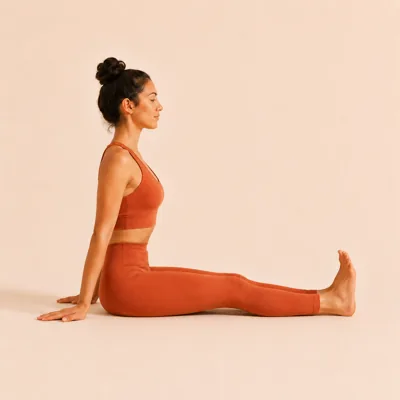
You sit with the legs extended straight in front, feet together or hip-width apart, press the backs of the thighs down and flex the feet so the toes draw back toward you. The hands press into the floor beside the hips, the shoulders draw down and back, and the spine rises tall from the base.
The engagement is the point. A passive version, legs loose and spine slumped, is just sitting on the floor. Pressing the thighs down and flexing the feet switches the legs on, and that engagement is what supports the pelvis and lets the spine lengthen rather than round.
It is the reference posture for seated forward bends. Seated Forward Bend is Dandasana folding forward, and if the Dandasana underneath it is collapsed, the fold will happen in the lower back rather than at the hips.
Tight hamstrings are the usual obstacle, and they pull the pelvis backward and round the lower back. Sitting up on the edge of a firm cushion tips the pelvis forward again and fixes it immediately.
How to practise it
-
Extend the legs
Sit on the floor with your legs extended straight out in front of you, feet together or hip-width apart. If the lower back rounds, sit up on the edge of a firm cushion or folded blanket.
-
Engage and lengthen
Press the backs of the thighs down and flex the feet, drawing the toes back towards you so the legs are active. Let the spine rise tall from the base, crown lifting.
-
Steady the spine
Press the hands into the floor beside your hips, draw the shoulders down and back, and breathe steadily. Stay tall and steady for the hold.
How long and how often
The app holds it for thirty seconds, which is long enough to feel the work. It is an active pose and thirty seconds of genuine engagement is more useful than two minutes of slumping.
Use it as the setup before seated forward bending, and as a check on your seated posture generally.
Keep a soft bend in the knees if straightening the legs is uncomfortable. Straight legs at the cost of a rounded back is the wrong trade.
What usually goes wrong
Letting the lower back round. The most common fault and almost always tight hamstrings pulling the pelvis back. Sit up on a cushion rather than fighting it.
Leaving the legs passive. Without the thighs pressing down and the feet flexed, this is not the pose. The engagement is what distinguishes it from ordinary sitting.
Hunching the shoulders forward. The hands press down beside the hips to help the shoulders draw back and down, not to prop up a collapsed torso.
Forcing the knees straight. A soft bend with a long spine beats locked knees with a rounded one every time.
Who should take care
Practise safely. Sit up on a cushion if the lower back rounds or the hamstrings feel tight. This lets the spine stay tall. Keep a soft bend in the knees if straightening the legs is uncomfortable. See our full Health & Safety Disclaimer.
Thirty seconds, actively
PanchPrana holds Staff Pose long enough for the engagement to register, which is what separates it from sitting down. It is one of the 66 techniques that are free to practise in full, with no account needed.


Common questions
Why does my lower back round?
Usually tight hamstrings tipping the pelvis backward. Sit up on the edge of a firm cushion or folded blanket and the spine will lengthen on its own.
Should my legs be straight?
As straight as is comfortable. Keep a soft bend in the knees if straightening them is uncomfortable, and prioritise a tall spine over straight legs.
Is it really an active pose?
Yes. The thighs press down, the feet flex, the spine lengthens and the shoulders draw back. Done passively it is not the pose.
What is it preparing me for?
Seated forward bends in particular, and seated posture generally. Seated Forward Bend is this pose folding at the hips.
How is it different from Easy Pose?
Easy Pose is a cross-legged resting seat for breathing practice. Staff Pose has the legs extended and is actively engaged. One is for settling, the other is for working.