On this page
Mountain Pose is the standing equivalent of Staff Pose: it looks like doing nothing and is the reference for everything else. Every standing posture starts from this alignment, and the sun salutation both begins and ends here. Learning to stand well is what makes the rest of the standing work make sense.
What it is
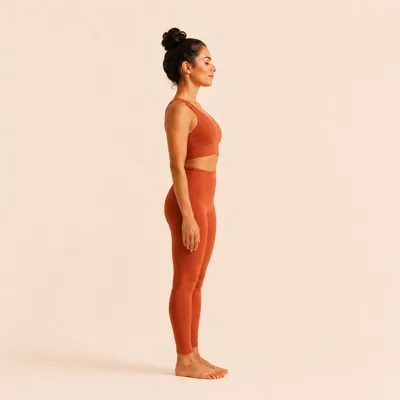
You stand with the feet together or hip-width apart, whichever is more stable, and spread the weight evenly across both feet, front to back and inner to outer edge. The spine rises tall with the crown lifting, the shoulders soften down, and the arms hang easily.
Even weight is the instruction people gloss over. Most of us stand with more weight on one foot, or forward on the toes, or rolled to one edge. Deliberately distributing it across four points of each foot is a noticeable change, and it is the foundation of every balance pose that follows.
Lengthening up without arching the lower back is the other half. The crown lifts, but the ribs do not thrust forward. Standing tall by arching the lumbar spine is a very common substitution and it is exactly what the pose is trying to correct.
It is safe for everyone. If balance feels wobbly, taking the feet a little wider is a legitimate version rather than a lesser one.
How to practise it
-
Find your stance
Stand at the front of your mat with your feet together or hip-width apart, whichever feels more stable. Spread the weight evenly across both feet, front and back, inner and outer edges, so you feel grounded and balanced.
-
Ground and lengthen
Let the spine rise gently tall, crown of the head lifting towards the ceiling, without arching the lower back. Soften the shoulders down away from the ears and let the arms hang easily by your sides, palms facing forward.
-
Steady and breathe
Relax the face and jaw and breathe smoothly through the nose. Feel steady and still, rooted down through the feet and light through the crown. Stay for a few easy breaths.
How long and how often
The app holds it for twenty seconds, which is enough to establish the alignment before moving on. It is a setup posture more than a destination.
Its real use is as a reference. Returning to it between standing poses lets you notice what has shifted, and it is where each sun salutation resets.
Keep the knees soft rather than locked. Locking them pushes the pelvis forward and takes the work out of the legs.
What usually goes wrong
Locking the knees. A locked knee tips the pelvis and hands the job of standing to the joint rather than the muscles. Soft, not bent.
Arching the lower back to stand tall. Lifting through the crown should lengthen the spine, not thrust the ribs forward. The app says never to force the lower back to arch.
Weighting one foot. Standing habitually on one side is so normal that even weight feels odd at first. That oddness is the useful part.
Treating it as a rest between poses. It is an active posture. Standing slackly in it between Warriors misses what it is for.
Who should take care
Practise safely. Safe for everyone. If balance feels wobbly, take the feet a little wider. Keep the knees soft rather than locked, and never force the lower back to arch. See our full Health & Safety Disclaimer.
Twenty seconds to set the alignment
PanchPrana holds Mountain Pose before the standing work so the alignment is set rather than assumed. It is one of the 66 techniques that are free to practise in full, with no account needed.


Common questions
Feet together or apart?
Whichever is more stable for you. Together is the classical version; hip-width is steadier and entirely acceptable, particularly if balance is wobbly.
Should my knees be locked?
No. Keep them soft. Locking them pushes the pelvis forward and takes the legs out of the work.
What does even weight mean?
Front to back and inner to outer edge of each foot, and evenly between the two feet. Most people stand off-centre without noticing, which is what makes this worth doing deliberately.
Why is it called an active pose?
Because the feet ground, the legs engage and the spine lengthens. Standing slackly in the same outline is not the pose.
Where does it appear in the sun salutation?
It is where the sequence begins and ends, and where each half round resets before the next.