On this page
Seated Forward Bend is measured by most people in how close their forehead gets to their shins, which is the wrong measure and produces the wrong pose. The fold happens at the hips. Rounding the lower back to get the head down looks like more range and is a different, less useful and less comfortable shape.
What it is
You sit tall with both legs extended, feet together and flexed, inhale and lengthen up through the spine with the arms overhead, then exhale and hinge forward from the hips, walking the hands down the legs to wherever you reach comfortably.
Hinging from the hips means the pelvis rotates forward over the legs and the spine stays long. Rounding from the waist means the pelvis stays put and the spine curves. The first stretches the hamstrings and the whole back of the body; the second mostly compresses the lumbar spine.
Tight hamstrings prevent the pelvis rotating, which is why nearly everyone rounds. The fixes are straightforward: sit up on a folded blanket, bend the knees as much as you need, and hold a strap around the feet rather than straining to reach them. All three are standard equipment rather than concessions.
It is a quietening pose. The longer you stay in it, the more the attention turns inward, which is why it often appears toward the end of a practice.
How to practise it
-
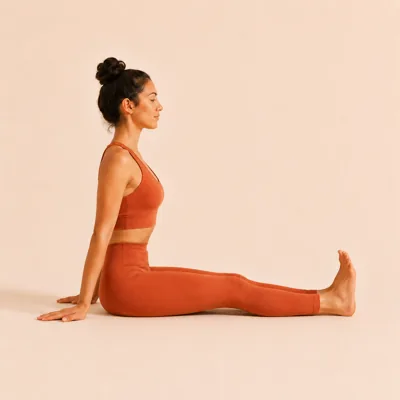
Sit with the legs extended
Sit tall with both legs extended straight in front of you, feet together and flexed. Sit up on a folded blanket or cushion if the lower back rounds.
-
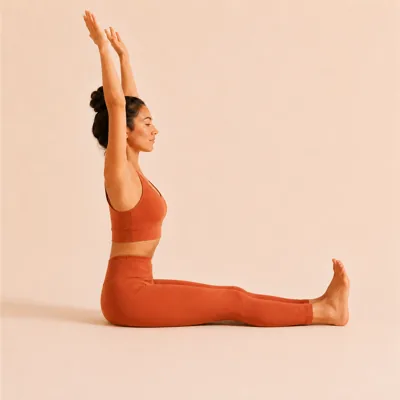
Lengthen the spine
Inhale and lengthen up through the spine, reaching the arms overhead. Feel the whole torso grow taller before you begin to fold.
-
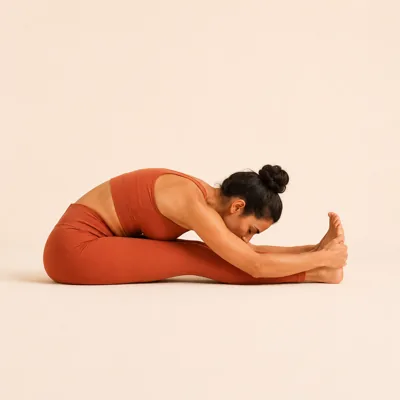
Fold and soften
Exhale and hinge forward from the hips, walking the hands down the legs to the shins, ankles, or feet. Wherever you reach comfortably. Let the head and shoulders relax, keep the knees softly bent if the hamstrings are tight, and breathe steadily. With each exhale let the fold deepen a little on its own.
-
Rise back up
Inhale and lead with the chest to rise back up, sweeping the arms overhead again as the spine lengthens tall.
-
Return to seated
Exhale and lower the arms, returning to a tall, easy seated posture with the legs extended.
How long and how often
Several steady breaths in the fold, longer if it is comfortable. This is a pose that rewards staying rather than pushing.
Lengthen on each inhale and soften a little further on each exhale, rather than arriving at a depth and holding it rigidly.
Rise by leading with the chest and sweeping the arms overhead, which keeps the spine long on the way out as well as on the way in.
What usually goes wrong
Rounding the lower back to reach further. The most common fault. Bend the knees instead. A fold with straight legs and a rounded spine is doing less than a fold with bent knees and a long one.
Pulling on the feet. Hauling yourself down with the hands forces the shape rather than letting it open. Hold a strap and let the breath do it.
Skipping the lengthening. The inhale with the arms overhead is not decorative. It creates the length the fold then happens within.
Locking the knees. Keep them softly bent. Locked knees combined with a strong forward pull is hard on the hamstring attachments.
Who should take care
Practise safely. Bend the knees as much as you need and hold a strap around the feet rather than straining to reach them. Fold from the hips, not by rounding the lower back. Ease off or skip this if you have a back injury, and come up slowly. See our full Health & Safety Disclaimer.
Fold, and stay a while
PanchPrana cues the lengthening before the fold and the lead with the chest on the way back up, which are the two moments that keep the spine long. It is one of the 66 techniques that are free to practise in full, with no account needed.


Common questions
Should my legs be straight?
Bend the knees as much as you need. A long spine with bent knees is the pose; straight legs with a rounded back is not.
How do I know if I am folding from the hips?
The lower back stays long and the movement feels like the pelvis tipping forward. If the first thing that happens is your back curving, you are folding from the waist.
I cannot reach my feet.
Hold a strap looped around them, or rest the hands on the shins or ankles. Reaching the feet is not what the pose is for.
Why sit on a cushion?
It tips the pelvis forward, which is exactly the movement tight hamstrings prevent. It often transforms the pose in one adjustment.
Who should skip it?
The app advises easing off or skipping it if you have back problems. Forward folding under load is not kind to an irritated lower back.