On this page
Standing Forward Bend appears twice in every half round of a sun salutation, which makes it one of the most repeated shapes in the practice. Two things about it are worth getting right early: the knees should be far more bent than most people allow, and you should come up slowly, because this is the one pose in the library with a specific caution about standing up.
What it is
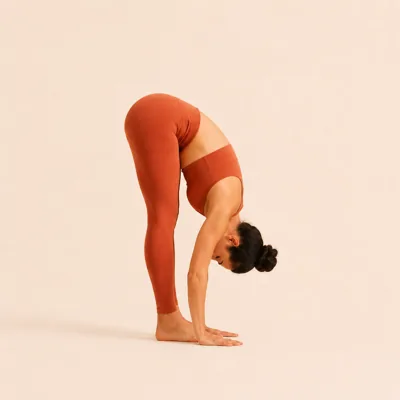
From standing you inhale and sweep the arms overhead, then exhale and hinge forward from the hips, letting the head and arms hang toward the floor. The hands rest on the floor, the shins, or blocks. The neck relaxes completely and the crown of the head drops.
The hanging is the point. Unlike the seated fold, which is a sustained stretch, this one is largely about release: the neck and shoulders let go, the spine lengthens under its own weight, and the breath settles. Gripping anywhere defeats it.
Bending the knees generously is what allows the fold to happen at the hips. Straight legs with tight hamstrings force the movement into the lower back. In the sun salutation context the app is explicit that beginners should keep a generous bend.
The caution is about blood pressure and dizziness. Having the head below the heart and then standing up is the mechanism, which is why the guide says to rise slowly, rolling up one vertebra at a time.
How to practise it
-
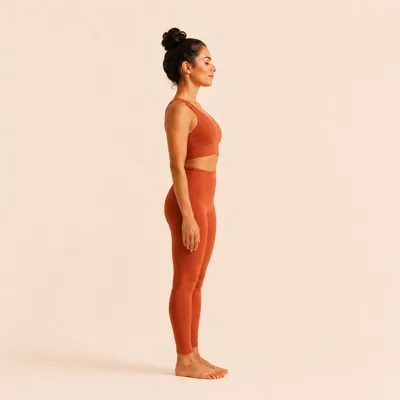
Start standing
Stand tall with the feet together or hip-width apart, arms relaxed at your sides.
-
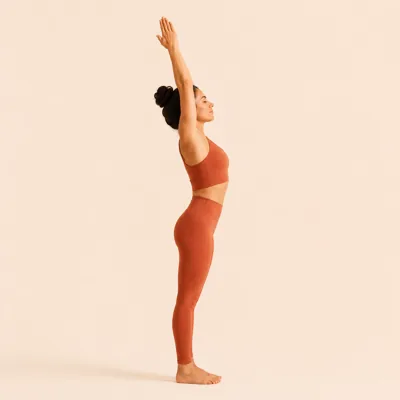
Reach up
Inhale and sweep the arms overhead, lengthening the spine and lifting the chest.
-
Fold from the hips
Exhale and hinge forward from the hips, letting the head and arms hang towards the floor.
-
Let go and hang
Rest your hands on the floor, your shins, or blocks. Let the neck relax completely and the crown of the head drop.
-
Rise back up
Inhale and rise from the hips, sweeping the arms back overhead as the spine lengthens.
-
Return to standing
Exhale and lower the arms, returning to standing tall.
How long and how often
Inside a sun salutation it is the length of one exhale. On its own, several slow breaths hanging is a good hold.
Rise slowly and roll up one vertebra at a time. This is the part of the instruction most often ignored and the one with a reason attached.
Blocks under the hands are worth having if the floor is a long way away. They raise the floor rather than lowering your standards.
What usually goes wrong
Straight legs at all costs. Bend the knees generously. The fold belongs at the hips, and straight legs with tight hamstrings put it in the lower back instead.
Holding the head up. Let the neck go completely and the crown drop. Looking forward keeps the neck working in a pose whose main benefit is releasing it.
Bouncing. Pulsing deeper into the fold is a way to overstretch a hamstring. Hang still and let it lengthen.
Standing up quickly. Roll up slowly. The app names dizziness and blood pressure as reasons this pose may not suit you at all, and a fast rise is the moment those matter.
Who should take care
Practise safely. This pose isn't recommended if you have dizziness, low or high blood pressure, or a recent back injury. Rise slowly, rolling up one vertebra at a time. See our full Health & Safety Disclaimer.
Fold on the exhale, rise slowly
PanchPrana cues the generous knee bend and the slow roll back up, which are the two instructions that get lost when this pose is repeated eight times in a sun salutation. It is one of the 66 techniques that are free to practise in full.


Common questions
How much should I bend my knees?
Generously, particularly as a beginner. There is no target for straight legs and a bent-knee fold from the hips is the better pose.
Where should my hands go?
The floor, your shins, or blocks. Whichever lets the upper body hang without straining.
Who should avoid this pose?
The app says it is not recommended if you have dizziness, low or high blood pressure, or a recent back injury.
Why does it make me lightheaded?
The head is below the heart and then you stand up. Rising slowly, one vertebra at a time, is the standard precaution.
Should I feel it in my hamstrings?
Often, yes, along with a release through the back and neck. It should be a stretch rather than a sharp pull, and bending the knees more will ease it.