On this page
Raised Arms Pose is the second posture of the sun salutation and the one where the lower back most often takes a load it should not. The arms sweep overhead, the body arches gently, and the whole question is where that arch happens. It should be an opening across the chest, not a hinge at the waist.
What it is
From standing tall you inhale and sweep both arms up alongside the ears, reaching through the fingertips and lengthening the whole side body, then arch gently back leading with the chest. The gaze lifts only as far as the neck is comfortable with.
The lengthening comes before the arching. Reaching up creates length through the spine, and the arch then happens within that length. Arching without reaching first compresses the lower back, which has the least room to give.
The slight bend in the knees is a specific protection. Locked legs transmit the arch straight into the lumbar spine; soft knees let the pelvis adjust underneath it.
It encourages a full inhale, which is why it sits where it does in the sequence. Opening the front of the body and breathing in at the same time reinforce each other.
How to practise it
-
Start tall
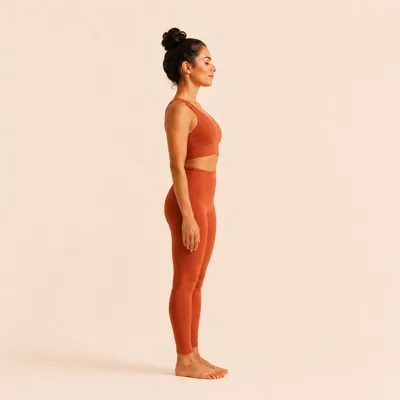
Begin standing tall with the feet together and the weight even. Take a steady breath to prepare.
-
Sweep the arms up
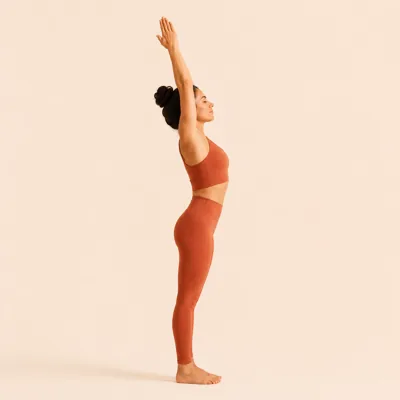
Inhale and sweep both arms up alongside your ears. Keep the arms shoulder-width apart if that feels easier. Reach up through the fingertips and lengthen the whole side body.
-
Open the chest
Gently arch back, leading with the chest and lifting up and over rather than collapsing into the lower back. Look up only as far as is comfortable for your neck. Breathe and hold lightly.
How long and how often
The app holds it for twenty seconds as a standalone posture. Inside a sun salutation it is the length of one inhale.
Keep the arms shoulder-width apart rather than squeezed together if that is easier, which it is for most people with tight shoulders.
Keep the arch small and the gaze forward if you have back or neck issues, which is what the app advises. Come out slowly.
What usually goes wrong
Arching before lengthening. Reach up first, then arch within that length. Going straight into the bend folds the lower back rather than opening the chest.
Locking the knees. A slight bend protects the lower back. Straight locked legs send the whole arch into the lumbar spine.
Dropping the head back. Look up only as far as the neck is comfortable with, and after the chest has lifted. Leading with the head is the usual cause of a sore neck afterwards.
Forcing the arms together behind the ears. Shoulder-width is a legitimate and often better position. Squeezing them together tends to hunch the shoulders up around the neck.
Who should take care
Practise safely. Keep a slight bend in the knees to protect the lower back. If you have back or neck issues, keep the arch small and the gaze forward. Come out slowly. See our full Health & Safety Disclaimer.
One inhale, opened properly
PanchPrana cues the reach before the arch, which is the order that keeps the lower back out of it. Raised Arms Pose is one of the 66 techniques that are free to practise in full, with no account needed.


Common questions
Should my arms be together or apart?
Shoulder-width apart is easier for most people and works perfectly well. Together alongside the ears is the classical shape but needs open shoulders.
How far should I arch back?
Only as far as is comfortable, and led by the chest. Keep it small if you have any back or neck issues.
Why keep the knees bent?
A slight bend lets the pelvis adjust and protects the lower back. Locked legs push the arch straight into the lumbar spine.
Where should I look?
Up only as far as the neck stays comfortable. Forward is fine, and is the better choice if the neck is at all sensitive.
Which breath goes with it?
An inhale. The pose opens the front of the body, which is what a full inhale wants.