On this page
A day spent leaning toward a screen closes the front of the body and rounds the upper back. The standing back bend is the direct answer to that, and it goes wrong in one specific way: people bend from the lower back and throw the head back, which compresses exactly the place that is already taking the strain.
What it is
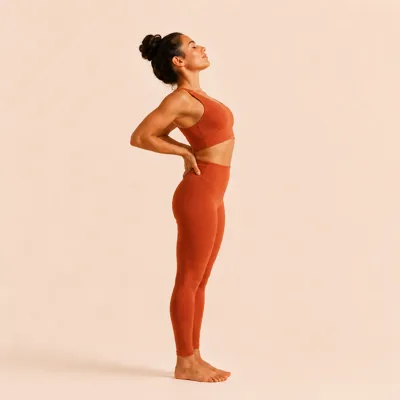
You stand tall with the feet about hip-width apart, bring the hands to support the lower back with the fingers pointing down, and draw the elbows gently toward each other. Then you breathe in, lift the chest up and gently back, and hold for about half a minute breathing steadily.
The hands are structural rather than decorative. Supporting the lower back gives the lumbar spine something to work against and makes it much harder to simply collapse backward into it. Drawing the elbows toward each other opens the chest at the same time.
The instruction to lead with the chest is the whole technique. The lift comes from the sternum rising up and then back, which extends the upper back where the range actually is. Dropping the head first produces a bend centred in the neck and lower back, which is where the range is not.
How to practise it
-
Support the lower back
Stand tall with the feet about hip-width apart. Bring your hands to support your lower back, fingers pointing down, and draw the elbows gently towards each other.
-
Lift and open
Breathe in and lift the chest up and gently back, leading with the heart rather than dropping the head. Look up only as far as is comfortable and hold there for half a minute, breathing steadily, then return to standing.
How long and how often
One hold of about half a minute, breathing steadily throughout. It is a short practice and does not need repeating several times.
It suits a break from desk work and the warm-up before a standing practice. It also works as a counter-pose after anything involving forward folding.
Keep the lift small. This is not a pose that improves by going further, and the range that matters is in the upper back rather than in how far back the head goes.
What usually goes wrong
Dropping the head back first. The chest leads, and the head follows only as far as is comfortable. Throwing the head back is the most common fault and the one most likely to leave the neck sore.
Bending from the lower back. Hinging at the waist compresses the lumbar spine. The hands supporting it and the chest leading are both there to prevent exactly this.
Going too far. A small, controlled lift does the job. The app says to keep the bend small, and depth here buys nothing.
Holding the breath. You are in the shape for half a minute and breathing steadily through it is part of the practice. Bracing and holding makes the position rigid.
Who should take care
Practise safely. Keep the bend small and led by the chest, and support the lower back with the hands throughout. Skip or keep it very gentle if you have lower-back or neck issues, and never force the range. See our full Health & Safety Disclaimer.
Half a minute, held steadily
PanchPrana sets up the hand position first and then times the hold, so the lift stays controlled rather than creeping deeper as the seconds pass. It is one of the 66 techniques that are free to practise in full, with no account needed.


Common questions
Where exactly do the hands go?
On the lower back with the fingers pointing down, elbows drawing gently toward each other. They support the lumbar spine and open the chest at the same time.
How far back should I look?
Only as far as is comfortable, and after the chest has lifted rather than before. If the neck feels crunched, look forward and up instead.
Who should skip it?
The app advises skipping it or keeping it very gentle if you have lower-back or neck issues. That is worth following rather than adapting.
Is it a counter-pose to forward bends?
It works well that way, yes. It extends the spine in the opposite direction to a forward fold and opens the front of the body.
How long should I hold?
About half a minute, breathing steadily. One hold is enough.