On this page
Calf raises are the only movement in this warm-up family that ask for a little strength rather than only range. Rising onto the balls of the feet and lowering back down works the calves, mobilises the ankles, and puts you briefly on a small base, which makes it quiet balance practice as well.
What it is
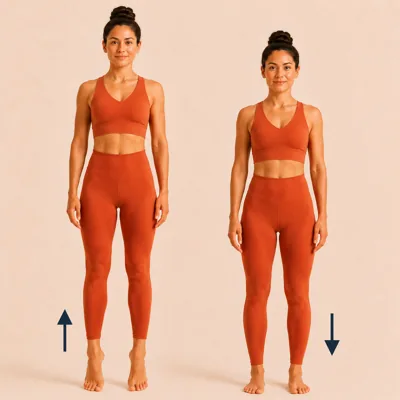
You stand with the feet about hip-width apart and the weight even, rise slowly onto the balls of the feet lifting the heels as high as is comfortable, then lower back down with control. Three rounds. A hand on a wall or chair for balance is entirely reasonable.
The lowering is as much of the movement as the lifting. Coming down slowly rather than dropping is what makes it useful, and it is the half people tend to hurry.
It brings circulation into the lower legs and feet, which is welcome after sitting, and it wakes up the ankles before standing postures. Because it narrows your base of support it also asks the ankles to stabilise, which is the balance element.
How to practise it
-
Stand steady
Stand tall with the feet about hip-width apart and the weight even across both feet. Rest a hand on a wall or chair for balance if you like.
-
Rise and lower
Slowly rise up onto the balls of your feet, lifting the heels as high as is comfortable, then lower the heels back down with control. Repeat for three rounds.
How long and how often
Three rounds, rising and lowering slowly. That is under a minute. It suits the start of a standing practice and any break from a chair.
Keep the lift smaller if the calves or ankles feel tight. A small controlled rise is worth more than a high wobbly one.
Use support whenever you want it. Holding a wall does not reduce what the calves are doing; it only removes the balance element, which is not the main point.
What usually goes wrong
Bouncing. Rising and dropping quickly turns this into a bounce that uses tendon recoil rather than muscle. Slow up and slow down is the instruction.
Dropping the heels. Letting the heels fall is the half of the movement most often skipped, and it is where the control is. Lower deliberately.
Rolling onto the outside of the feet. Weight should stay even across the ball of the foot. Rolling to the little-toe side is common as the calves tire and puts the ankle in a poor position.
Refusing support. Wobbling through it on principle makes the movement worse. Rest a hand on a wall and do it properly.
Who should take care
Practise safely. Rise and lower slowly and with control rather than bouncing. Use support for balance if needed, and keep the lift smaller if the calves or ankles feel tight. See our full Health & Safety Disclaimer.
Three rounds, slowly
PanchPrana counts the rounds and keeps the pace slow enough that the lowering does not get rushed. Calf raises are one of the 66 techniques that are free to practise in full, with no account needed.


Common questions
How high should I lift?
As high as is comfortable. If the calves or ankles feel tight, a smaller lift done with control is better than a maximum one.
Can I hold onto something?
Yes. A wall or the back of a chair is sensible, particularly at first. It does not reduce the work in the calves.
Is this strength work or mobility?
A little of both. The calves work and the ankles move, which is why it sits among the warm-up movements rather than in a strength routine.
Should I feel a stretch?
Not particularly. You may feel the calves working, and a stretch through the front of the ankle at the top. Neither should be strong.
What does it prepare me for?
Standing postures generally, and balance poses such as Tree Pose in particular, where the ankle has to make constant small adjustments.