On this page
Tree Pose has one rule that is not negotiable and a great deal else that is. The rule is that the lifted foot rests against the calf or the inner thigh, never against the side of the knee. Everything else, how high the foot goes, whether you hold a wall, how much you wobble, is open.
What it is
You shift your weight into one foot, grounding down through all four corners, turn the other knee out and rest that sole against the inner calf or inner thigh of the standing leg. Then you grow tall and steady, and hold with an even breath before changing sides.
The knee placement rule exists because the knee is a hinge with very little tolerance for sideways force. A foot pressed into the side of it applies exactly that, held for as long as the pose lasts. Calf or thigh are both fine; the joint between them is not.
Balance is not a fixed quality you either have or lack. It is produced by constant small corrections at the ankle and hip, which means wobbling is the mechanism working rather than the pose failing. The app says as much: wobbling is part of it.
A soft standing knee is the other technical point. Locking it out feels more stable for a moment and removes the ability to make those small corrections, which makes the balance worse rather than better.
How to practise it
-
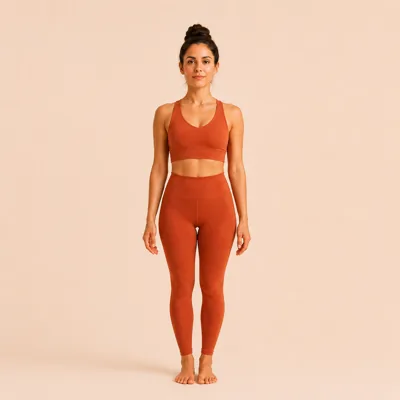
Start in Standing Pose
Stand tall, feet together or hip-width apart, weight even through both feet. Relax your shoulders, lengthen your spine, and take a few steady breaths here before you begin.
-
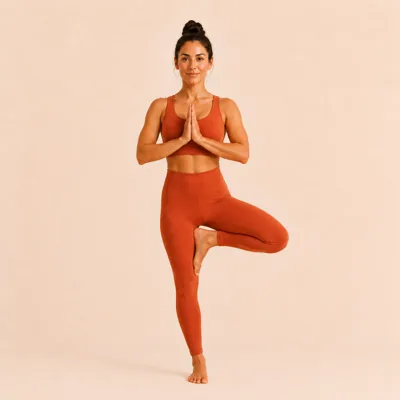
Root the left leg and lift into Tree
Shift your weight into your left foot, grounding down through all four corners. Turn the right knee out and rest the sole of the right foot against the inner left calf or inner thigh. Never on the knee. Find a steady point to gaze at, lengthen up, and breathe.
-
Return to centre
Lower the right foot back down and return to Standing Pose. Take a breath here, letting both feet root evenly before you switch sides.
-
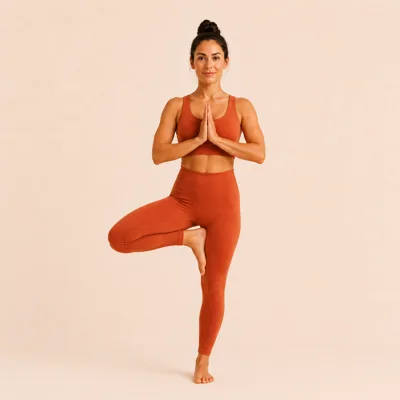
Root the right leg and lift into Tree
Shift your weight into your right foot, grounding down through all four corners. Turn the left knee out and rest the sole of the left foot against the inner right calf or inner thigh. Never on the knee. Find a steady point to gaze at, lengthen up, and breathe.
-
Return to centre
Lower the left foot back down and return to Standing Pose in the centre. Let your breath settle and notice how both sides feel.
How long and how often
Hold each side for several steady breaths, returning to standing between them. Practise evenly on both legs, which is easy to forget once one side goes better.
Use a wall or chair whenever you want it. Support does not reduce what the standing leg is doing; it removes the anxiety, which usually improves the balance.
A soft steady gaze on one point helps considerably. Balance is partly visual, and a wandering gaze makes it much harder.
What usually goes wrong
Foot against the knee. The one rule. Calf or inner thigh, never the knee joint itself. Sideways pressure on a knee held for thirty seconds is not something the joint is built for.
Locking the standing knee. A locked knee cannot make the micro-corrections balance depends on. Keep it soft.
Refusing support. A wall is not cheating. Using one lets you work on the alignment rather than on not falling over.
Treating a wobble as failure. The wobble is the balance system working. Keep breathing, keep the gaze steady, and let it settle.
Who should take care
Practise safely. Place the foot on the calf or thigh, never against the knee joint. Use a wall or chair for balance whenever you need it, and keep the standing knee soft. Wobbling is part of it. Keep breathing. See our full Health & Safety Disclaimer.
Both sides, with support if you want it
PanchPrana returns to standing between sides so both legs get the same, and it is explicit that a wall is there to be used. Tree Pose is one of the 66 techniques that are free to practise in full, with no account needed.


Common questions
Where exactly does my foot go?
Against the inner calf or the inner thigh of the standing leg. Never against the side of the knee, which the app states directly.
What if I cannot balance at all?
Rest a hand on a wall or chair, and start with the toes of the lifted foot still touching the floor and the heel against the ankle. That is a legitimate version to build from.
Why do I wobble so much?
Because balance is produced by constant small corrections rather than by holding still. Wobbling is the system working. A steady gaze and an even breath help it settle.
Should my standing knee be locked?
No. Keep it soft. Locking it removes the small adjustments that keep you upright.
How long should I hold?
Several steady breaths on each side. Even time on both legs matters more than a long hold on the good one.