On this page
Warrior 3 is the most demanding balance in the library, and it is one of the few poses where using support is not a fallback but the sensible way to learn it. Hands on a chair or a wall lets you work on the shape, which is where the difficulty actually is, rather than spending the whole hold trying not to topple.
What it is
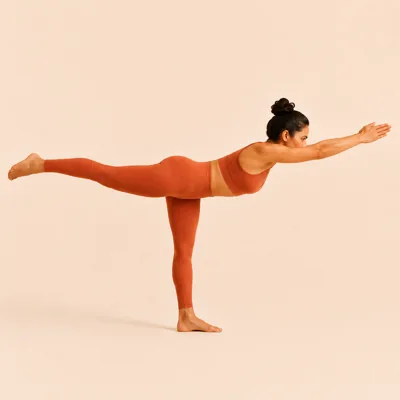
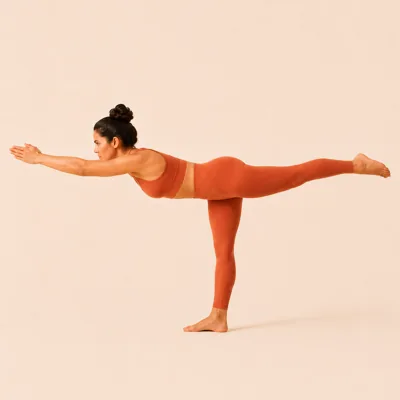
You bring your weight into one foot, grounding down firmly, then hinge forward from the hip and lift the other leg straight behind you as the torso lowers, until the body forms one long line roughly parallel to the floor. The arms reach forward, or stay at the chest.
The hinge is at the hip, not the waist. The torso and the lifted leg move as one piece, pivoting around the standing hip. Bending at the waist to get the chest down while the leg stays low produces a shape that looks similar and works quite differently.
Keeping the lifted-leg hip from opening out is the technical point people miss. The instinct is to let that hip roll upward, which makes the balance easier and turns the pose into a twist. The hips should stay level, facing the floor.
The standing knee stays soft. As with Tree Pose, locking it removes the small corrections balance depends on.
How to practise it
-
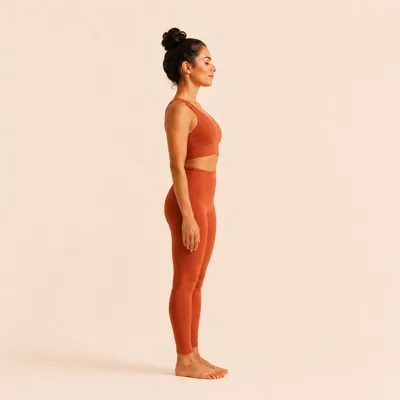
Begin in standing
Start standing tall at the front of your mat, feet grounded and weight even, arms relaxed by your sides.
-
Root the standing leg
Stand tall and bring your weight into the left foot, grounding down firmly. Rest your hands on a wall or chair in front of you for support if you'd like.
-
Hinge and reach
Hinge forward from the hip, lifting the right leg straight behind you as the torso lowers, until the body forms one long line parallel to the floor. Reach the arms forward or keep them at the hips, and fix your gaze on a steady point.
-
Return to standing
Lower the lifted leg with control and rise back up to standing before you switch sides.
-
Hold, then change sides
Breathing steadily, keeping the hips level and the lifted leg strong. Lower with control, then repeat balancing on the right foot.
-
Finish in standing
Lower the leg and return to a tall, even standing position.
How long and how often
Several steady breaths on each side, lowering with control and returning to standing before switching. Practise both sides evenly.
Use a wall or chair whenever you need it, which the app states plainly. Hands resting on a chair in front of you lets you build the shape and the strength before adding the balance.
Come down slowly rather than dropping the leg. The controlled lowering is part of the work.
What usually goes wrong
Letting the lifted hip open. The hips stay level and facing the floor. Rolling the lifted hip up makes the balance easier and converts the pose into a twist.
Hinging from the waist. The hinge is at the standing hip, with the torso and lifted leg moving as one line. Folding at the waist leaves the leg trailing low.
Locking the standing knee. Keep it soft. A locked knee cannot make the constant small adjustments that balance requires.
Avoiding support on principle. A chair under the hands is how this pose is sensibly learned. Wobbling through it unsupported means practising the wobble rather than the shape.
Who should take care
Practise safely. Use a wall or chair for support whenever you need it, and keep the standing knee soft rather than locked. Keep the lifted-leg hip from opening out, and come down slowly. Wobbling is normal. Keep breathing. See our full Health & Safety Disclaimer.
Both sides, with a chair if you want one
PanchPrana suggests support from the outset and returns to standing between sides. Warrior 3 is one of the 66 techniques that are free to practise in full, with no account needed.


Common questions
Can I use a wall or chair?
Yes, and it is recommended. Resting the hands on a chair in front of you lets you work on the shape rather than only on staying upright.
Where should my arms go?
Reaching forward, or kept at the chest, or resting on support. Arms forward is the hardest version; at the chest is easier and perfectly valid.
Why do my hips keep twisting?
Because letting the lifted hip open makes balancing easier. Keep both hips facing the floor even though it makes the pose harder.
How high should the lifted leg go?
To roughly parallel with the floor, forming one line with the torso. Lower is fine while you build strength; the line matters more than the height.
Is wobbling normal?
Yes. The app says so directly. Balance is produced by continuous small corrections, and the wobble is those corrections happening.