On this page
Belly breathing is the practice most often taught badly, usually as the instruction to "breathe deeply", which reliably produces a large effortful chest breath and leaves people feeling worse. The actual skill is close to the opposite. You are learning to breathe low and unhurried, so that the diaphragm does the work and the chest and shoulders stay out of it.
What it is
Belly breathing, or diaphragmatic breathing, means drawing the breath low enough that the belly moves outward on the inhale and settles back on the exhale, while the upper chest stays almost still. The diaphragm is doing what it is built to do, and the accessory muscles around the neck and shoulders are not being recruited to help.
Most people breathe higher than this most of the time, and higher still when stressed. A braced body produces a quick, shallow, upper-chest breath. That is not a fault of technique; it is simply what breathing looks like under load. The practice gives you a deliberate way back to the other pattern.
What people commonly report is that a few minutes of low, slow breathing settles them, and that the effect is easier to feel here than in more elaborate techniques. The yogic view treats the diaphragm as the accessible end of a system that is otherwise involuntary. Any stronger claim, that belly breathing treats a condition, would need clinical evidence and is not made here.
Its real importance is as a base skill. Three-part breath extends it upward through the ribs and chest. Extended exhale, coherent breathing and box breathing all assume you can already breathe low without thinking about it. Time spent here is not time away from the other practices.
How to practise it
-
Get comfortable, sitting or lying down
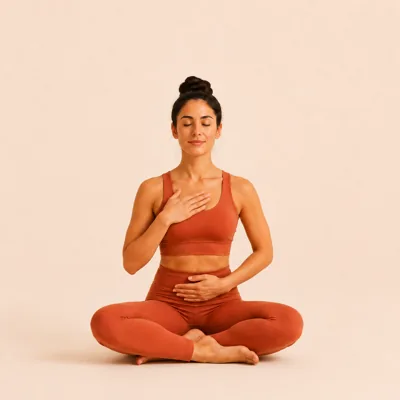
You can practise this one either way. Sit tall in a chair or cross-legged, or lie on your back with the knees bent. Lying down often makes the belly movement easiest to feel at first. Rest one hand on the belly and one on the chest.
-
Feel the two hands
Aim to move the lower hand while the upper hand stays almost still. That tells you the diaphragm is doing the work rather than the chest.
-
Rise and fall
Inhale through the nose and let the belly gently balloon outward; exhale and let it sink back. Keep the shoulders relaxed and still.
How long and how often
The app runs twelve rounds, which takes two to three minutes at an easy pace. That is a good daily dose and a good length to start with.
Because it is gentle and unforced, it does not need an empty stomach and it carries no progression to climb. Once the movement is reliable, the useful next step is not more rounds but using it elsewhere: as the breath you return to between rounds of a stronger practice, and as the pattern you fall back into during the day when you notice the breath has climbed into the chest.
Practising it lying down for the first week is worth doing even if you intend to sit. The floor supports the back, the belly moves more freely, and the two-hand test is far easier to read.
What usually goes wrong
Pushing the belly out with the abdominal muscles. The belly moving is a consequence of the diaphragm descending, not an action you perform. If you are consciously pushing the wall of the abdomen outward, the breath is not necessarily going anywhere. Let the inhale cause the movement.
Making the breath big. Depth here means low, not large. An enormous inhale defeats the purpose, because filling the lungs to capacity brings the chest and shoulders straight back in. Keep the volume ordinary and the placement low.
Judging it by the upper hand alone. Some chest movement is normal and fine. The test is relative: the lower hand should move clearly more than the upper one. Chasing a completely motionless chest produces a stiff, held breath.
Giving up because nothing moves. A belly that will not move usually means the posture is closing it down or the breath is being taken too quickly. Lie on your back with the knees bent, slow the inhale, and give it a fortnight. This is a skill that returns rather than one you either have or do not.
Who should take care
Practise safely. Keep it soft and unforced. This is a gentle practice suitable for anyone, any time. If you ever feel lightheaded, return to your natural breath. See our full Health & Safety Disclaimer.
Twelve rounds, cued aloud
The hardest part of belly breathing early on is keeping the pace slow while you are also trying to feel what is moving. PanchPrana cues each phase so you can close your eyes and follow, and belly breathing is one of the 66 techniques that are free to practise in full, with no account needed.


Common questions
Should I breathe through my nose or my mouth?
Through the nose, both ways. Nasal breathing slows the air and warms it, and it makes the low, quiet breath this practice wants much easier to hold on to.
Is belly breathing the same as diaphragmatic breathing?
Yes. The two names describe the same practice from different ends: the belly is what you can see moving, and the diaphragm is what is doing it.
Why do I feel lightheaded?
Almost always because the breath has become bigger or faster than usual rather than lower. Return to your natural breath for a minute, then start again with a smaller, slower inhale. Lightheadedness is a signal to do less, not to push through.
Can I practise this lying in bed at night?
Yes, and it suits that well. Lying on your back with the knees bent is the easiest position to feel the movement in, and the practice is gentle enough that falling asleep partway through is not a problem.
How is this different from three-part breath?
Belly breathing works the lowest part of the movement only. Three-part breath keeps that and then continues the same inhale up through the ribs and into the upper chest, releasing in reverse. Belly breathing first; three-part breath once it is easy.