On this page
Three-part breath is belly breathing continued upward. Where belly breathing stops once the lower breath is working, this carries the same inhale on through the ribs and into the upper chest, then empties from the top back down. The whole difficulty is keeping it as one movement, because the moment it becomes three separate actions it stops being a breath and starts being an exercise.
What it is
The three-part breath, Dirga Pranayama, divides the inhale into three stages you can feel in order. The belly expands first, then the ribcage widens, then the upper chest lifts. The exhale reverses it: the chest softens, the ribs draw in, and the belly falls last.
The staging is a teaching device more than an anatomical fact. Your lungs do not have three compartments. What the sequence does is give the attention somewhere specific to go, which is what stops the inhale from becoming a single hurried gulp, and it makes it obvious when part of the range is not being used.
The tradition treats this as the complete yogic breath and the reference breath that pranayama proper is built on. What people commonly report is that it feels fuller than ordinary breathing without feeling like effort, and that it is calming in its own right rather than only preparatory. Beyond that, claims about lung capacity or efficiency would need clinical evidence and are not made here.
How to practise it
-
Get comfortable
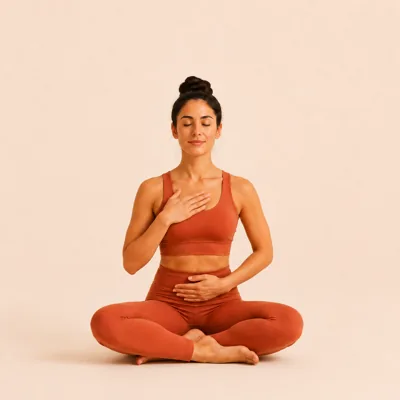
Sit tall or lie down with the spine long and easy. Resting one hand on the belly and one on the chest helps you feel the wave of the breath move through all three parts.
-
Fill in three stages
Inhale and let the belly expand first, then the ribcage widens, then the upper chest lifts. One smooth, continuous inhale, not three separate sniffs.
-
Empty in reverse
Exhale slowly from the top down: the chest softens, the ribs draw in, and finally the belly gently falls. Keep it unhurried and even.
How long and how often
The app runs ten rounds. At an unhurried pace that is roughly three minutes, and it is enough. This is a practice where a small number of well-shaped breaths is worth more than a long session of approximate ones.
Build it in the order the body learns it. Spend a week or two on belly breathing alone until the low movement is automatic, then add the ribs, then the chest. Trying to assemble all three on the first day is the usual reason it feels mechanical.
It suits the start of a session well, whether that session is breathwork or movement, and it is a reasonable practice to return to at any point in the day. Keep it away from a heavy meal, which makes the low part of the breath uncomfortable.
What usually goes wrong
Three sniffs instead of one inhale. The commonest fault by a distance. If there is a stop between the belly and the ribs, the wave has broken. Slow the whole inhale down until the three stages can run together without a pause, even if that means a much smaller breath.
Filling to capacity. The top of the inhale should feel comfortable rather than complete. Packing the lungs full tightens the neck and shoulders and makes the exhale a release of pressure instead of a slow settling.
Forgetting the exhale is also three parts. People learn the staged inhale and then let the exhale collapse in one go. Emptying from the top down is half the practice, and it is the half that does most of the settling.
Straining to squeeze the belly empty. The exhale ends when the belly has gently fallen, not when the last of the air has been forced out. Squeezing recruits exactly the muscles you were trying to release.
Who should take care
Practise safely. Keep it relaxed. Never force the lungs full or squeeze them empty. Breathe through the nose throughout, and return to your natural breath if you feel lightheaded. See our full Health & Safety Disclaimer.
Let the stages be cued
Three-part breath is much easier to learn when something else is naming belly, ribs and chest at the right moment, so you are not counting stages and breathing at the same time. PanchPrana cues each phase aloud, and this is one of the 66 techniques that are free to practise in full.


Common questions
Is Dirga Pranayama the same as three-part breath?
Yes. Dirga means long or complete, and the practice is also met as the complete yogic breath or full yogic breath. The app uses the plain English name with the Sanskrit given alongside.
Should I hold the breath at the top?
No. There is no retention in this practice. The inhale arrives at the top and the exhale begins. Holds belong to Antar Kumbhaka and to box breathing, and adding one here makes the wave harder to keep smooth.
How is this different from belly breathing?
Belly breathing trains the lowest part of the movement and stops there. Three-part breath keeps that and continues upward through the ribs and chest. Learn belly breathing first; this is the next step once the low breath is reliable.
I cannot feel my ribs widening. What now?
Rest your hands on the sides of the ribcage instead of on the belly and chest, with the fingers wrapping round toward the back. The sideways movement is easier to feel from the edges than from the front. It also helps to practise sitting rather than lying down.
Can I practise it lying down?
Yes, and it is a good way to learn the belly stage. Sitting suits the rib and chest stages better, because the ribcage can widen in every direction rather than being pressed against the floor.