On this page
Equal breathing is the first counted practice worth learning, and it is almost entirely without ornament. You breathe in for four and out for four, through the nose, with no pause at either end. Everything more complicated than this is a variation on it: box breathing adds a hold at each end, extended exhale tips the ratio, coherent breathing slows it down and fixes the rate.
What it is
Sama Vritti translates as equal movement, and the instruction is exactly that. The inhale and the exhale are made the same length, and both are kept smooth from beginning to end. The count itself is arbitrary. What the practice trains is evenness.
An ordinary unwatched breath is rarely even. The inhale tends to be quicker than the exhale, or the exhale trails off and the next inhale arrives early. Putting a matching count on both halves removes that asymmetry, and it gives the attention a simple, repeating shape to rest on, which is why it doubles as a concentration practice.
What people commonly report is that it steadies them without making them drowsy, which is the useful distinction between this and the longer-exhale practices. An even ratio tends to leave you level rather than sedated, so it suits the middle of a working day. Claims beyond that would need clinical evidence and are not made here.
How to practise it
-
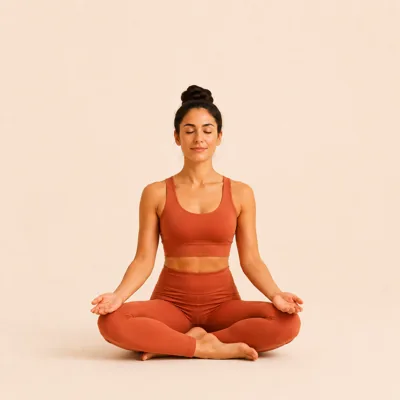
Sit comfortably
Choose any steady seated posture. Cross-legged on the floor, or feet flat on the floor in a chair. Let the shoulders drop, soften the face and jaw, and lengthen the spine.
-
Breathe through the nose
Keep the mouth closed and breathe softly in and out through the nose, letting the belly move rather than the chest.
-
Match the counts
Inhale for a count of four, then exhale for the same count of four. Keep both halves smooth and unhurried. No pause at the top or bottom.
-
Lengthen when ready
Once four feels easy, grow to five or six each side over time. Never strain: if the breath feels tight, shorten the count again.
How long and how often
The app runs twelve rounds at four counts each way, which comes to about two minutes. Daily is better than long. Ten minutes once a week does noticeably less than two minutes most days.
Lengthen only when four is genuinely easy, and lengthen both sides together: four becomes five, five becomes six. Six each way is a comfortable ceiling for most people and there is nothing to be gained from pushing past it in this particular practice. If the breath feels tight at any count, go back a number and stay there.
It suits almost any time of day and does not need an empty stomach. It is a good choice before something that needs concentration, and a good default when you want to practise but do not have a particular reason.
What usually goes wrong
Adding a pause at the top or bottom. The turn from inhale to exhale should be continuous. A held moment at either end turns this into box breathing, which is a different practice with different cautions. If a pause keeps creeping in, shorten the count.
Choosing a count you have to defend. Six sounds better than four and is worse if you cannot hold it smoothly. The right count is the one you could keep for the whole session without thinking about it.
Using it when you actually want to settle down. An even ratio steadies rather than sedates. If the aim is to come down from anxiety or to get to sleep, a longer exhale does that job better and this practice will feel like it is not working.
Counting in seconds you are checking. The count is a rhythm, not a measurement. Counting against a clock splits the attention and makes the breath jerky. Count at whatever pace feels even and let it be approximate.
Who should take care
Practise safely. This is a gentle, everyday breath suitable for anyone. Keep it soft and even, and simply return to your natural breath if you ever feel breathless or lightheaded. See our full Health & Safety Disclaimer.
A count you do not have to keep
Holding a rhythm while trying to settle is the awkward part of every counted practice. PanchPrana cues each phase aloud so you can close your eyes and follow, and equal breathing is one of the 66 techniques that are free to practise in full, with no account needed.


Common questions
What count should I use?
Four in and four out is the standard starting point and suits most people. Use three if four feels long. The number matters much less than keeping the two halves matched and the breath smooth.
Is equal breathing better than a longer exhale?
They do different jobs. An even ratio tends to leave you steady and alert, which suits daytime focus. A longer exhale tends to settle you down, which suits anxiety and sleep. Choose by what you want rather than by which is stronger.
How is this different from box breathing?
Box breathing is equal breathing with a hold added after the inhale and after the exhale, so all four phases match. Equal breathing has no holds at all, which makes it gentler and suitable for people who should avoid retention.
Can I practise it walking?
Yes, and matching the count to your steps is a well-established way to do it. Sit for it while you are learning the evenness, then take it walking once the rhythm is reliable.
Is it safe in pregnancy?
Equal breathing carries no retention and no forceful movement, which makes it one of the gentler practices. As with any breathing practice during pregnancy, keep it soft, do not lengthen the count, and check with your doctor or midwife first.