On this page
Coherent breathing has less technique in it than almost anything else in the library. There are no holds, no ratio to get right, no hand position and no sound. You slow the breath to about five or six breaths a minute with the inhale and exhale the same length, and then you keep doing that for long enough to matter.
What it is
The instruction is an even five-count in and five-count out, through the nose, with no pause at either end. Five and five gives you six breaths a minute; six and six gives you five. Both are within the range the practice is aiming at.
What separates it from equal breathing is the target rate. Equal breathing matches the two halves at whatever count suits you and is content at four. Coherent breathing is specifically about arriving at a slow rate, and the equality is in service of that rather than the point of it.
The idea of a resonant rate is that most people have a breathing pace at which the rhythms of breath and heart rate line up most smoothly, and that it sits for most adults somewhere around five to six breaths a minute. That is the standard account and it is why the practice is defined by a number rather than a feeling. What people commonly report is that ten minutes leaves them calm and clear-headed in a way two minutes does not. Anything stronger would need clinical evidence and is not claimed here.
How to practise it
-
Sit comfortably
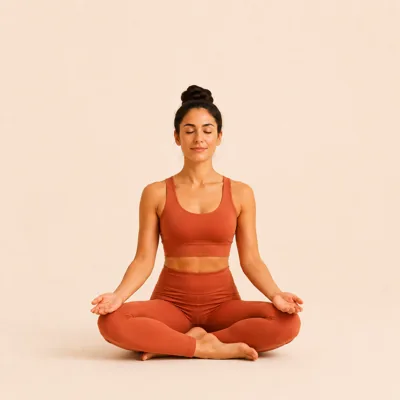
Choose any steady seated posture. Cross-legged on the floor, or feet flat on the floor in a chair. Let the shoulders drop and the spine rise gently tall.
-
Even and slow
Inhale for a smooth count of five and exhale for a smooth count of five, with no pause between. If five feels rushed, breathe more shallowly rather than speeding up.
-
Find your resonance
Some people settle best at six-in and six-out, others at five. Choose whatever lets the breath stay smooth and unforced, and keep it steady throughout.
How long and how often
The app runs twenty rounds, which at five and five is a little over three minutes. The guide is explicit that around ten minutes is where the fullest effect sits, so treat twenty rounds as a short session and build toward three of them.
This is the one practice in the library where length matters more than progression. There is nothing to lengthen except the session itself. Do not try to slow below five breaths a minute chasing a better number.
Find your own rate first. Try five and five for a few days, then six and six, and keep whichever stays smooth without any sense of reaching for air. Then stop adjusting it.
It is safe for daily practice and suits any time of day. Many people use it as the long, unremarkable practice they do most days, with the sharper techniques reserved for when they are needed.
What usually goes wrong
Breathing more deeply to fill the time. The commonest fault. Slowing the rate does not mean taking bigger breaths, and a large slow breath will make you lightheaded within a minute. If five counts feels like a long way to stretch the air, breathe more shallowly rather than more slowly.
Speeding up to keep the volume. The mirror of the same mistake. If the count starts drifting quicker as the session goes on, the breath is too big. Make it smaller and the pace holds by itself.
Treating it as a short practice. Three minutes of coherent breathing is fine and does much less than ten. This is the one to give real time to, and the one that rewards it.
Chasing a slower rate. Four breaths a minute is not a better version. The rate is meant to be the one where your breath is smoothest, and pushing past it turns an effortless practice into an effortful one.
Who should take care
Practise safely. Breathe through the nose, into the belly and ribs rather than the upper chest. Aim for around ten minutes for the fullest effect. Safe for daily practice; ease off if you feel breathless. See our full Health & Safety Disclaimer.
Ten minutes, paced without a clock
Holding five counts evenly for ten minutes is difficult to do while also watching the time. PanchPrana paces the whole session so the rate stays put, and coherent breathing is one of the 66 techniques that are free to practise in full, with no account needed.


Common questions
What is the right rate?
Somewhere between five and six breaths a minute for most people, which means a count of five or six each way. Choose whichever lets the breath stay smooth and unforced, then keep it steady rather than experimenting mid-session.
How long should a session be?
Around ten minutes for the fullest effect, which is what the app guide suggests. Shorter sessions are still worth doing; they simply do less.
Is this the same as resonance breathing?
The terms are used more or less interchangeably. Resonance breathing puts the emphasis on finding your own optimal rate; coherent breathing usually names a fixed rate of around six breaths a minute. The practice is the same.
Should I hold the breath at any point?
No. There are no retentions in this practice, and adding one changes it into box or triangle breathing. The inhale turns straight into the exhale.
Is it safe every day?
Yes, and daily is how it is meant to be used. It has no holds and no forceful movement. Ease off if you feel breathless, which usually means the breaths have become too large.