On this page
Cat and Cow is the movement most yoga practices open with, and it is one of the few where the breath is not an accompaniment but the thing setting the pace. Round the back as you breathe out, dip it as you breathe in, and let the length of the breath decide how fast the spine moves.
What it is
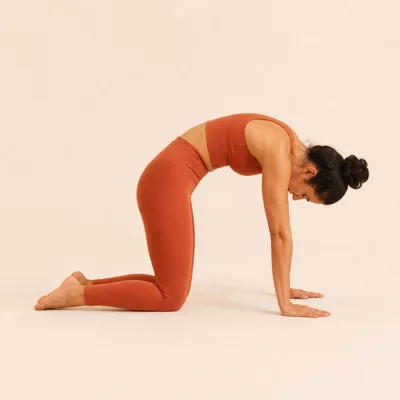
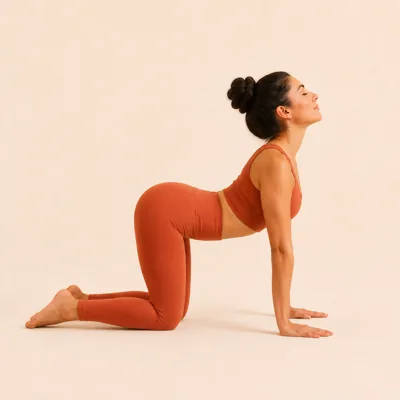
From a table-top position with the wrists under the shoulders and the knees under the hips, you alternate between two shapes. Cat rounds the back on the exhale, tucking the chin and the tailbone and drawing the navel up toward the spine. Cow dips the back on the inhale, lifting the chest and tailbone and letting the belly soften toward the floor.
Between them they take the spine through flexion and extension along its whole length, which is more than most single movements manage. That is why it works as a general warm-up rather than as a stretch for one area.
Pairing the breath with the shape is not decorative. Exhaling naturally draws the belly in and helps the back round; inhaling naturally expands the front and helps it dip. The movement and the breath are doing the same thing, which is why the pairing is that way round and not the reverse.
How to practise it
-
Come to all fours
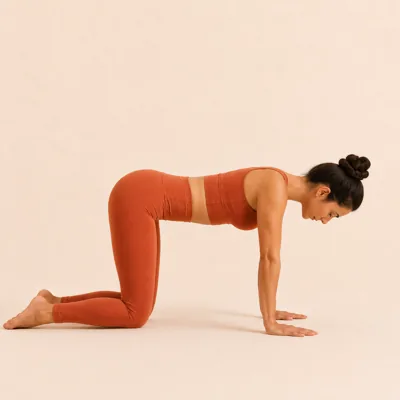
Come onto your hands and knees in a table-top position, with the wrists under the shoulders and the knees under the hips. Let the spine start out long and level.
-
Round into Cat
Breathe out and round the back, tucking the chin and tailbone, and drawing the navel up towards the spine.
-
Dip into Cow
Breathe in and dip the back, lifting the chest and tailbone, and letting the belly soften towards the floor.
-
Return to neutral
After completing desired number of rounds, return to a neutral table-top position, with the spine long and level.
How long and how often
Three rounds is the app default and it is a genuine warm-up rather than a token one, because each round takes a full breath in each direction. Let each round feel a little easier than the last.
It suits the opening of any movement practice and works well before seated breathing too, since a spine that has moved sits upright more comfortably.
Keep the range small if you have any back or wrist issues, which is what the app advises. A folded blanket under the knees is worth having if they feel tender.
What usually goes wrong
Rushing. The breath sets the pace and the breath is slow. Moving faster than the breath turns the sequence into a flap and skips most of the spine.
Pairing the breath backwards. Exhale into Cat, inhale into Cow. Doing it the other way round works against what the breath is already doing to the trunk and makes both shapes harder.
Cranking the neck. The head follows the spine rather than leading it. Throwing the head back in Cow is a common way to make the neck sore and adds nothing.
Loading the heels of the hands. Weight through the whole hand with the fingers spread, not dumped into the wrist crease. This is the main reason wrists ache in table top, and the wrist sequence beforehand helps.
Who should take care
Practise safely. Keep the movement smooth and comfortable and let the breath set the pace. Pad the knees with a folded blanket if they feel tender, and keep the range small if you have any back or wrist issues. See our full Health & Safety Disclaimer.
Three rounds, breath-led
PanchPrana cues each shape with its breath, which is the simplest way to keep the pace slow enough for the whole spine to move. Cat and Cow is one of the 66 techniques that are free to practise in full, with no account needed.


Common questions
Which breath goes with which shape?
Exhale as you round into Cat, inhale as you dip into Cow. That is the direction the breath is already moving the trunk, so the two work together.
My wrists hurt in table top. What can I do?
Spread the fingers and press through the whole hand rather than the heel. Warming the wrists up first helps considerably. If it persists, a fist position or forearms down are alternatives worth asking a teacher about.
How far should I round and dip?
Comfortably, and less than you probably think. Keep the range small if you have any back issues. A moderate range moved slowly does more than a maximum one.
My knees are sore on the floor.
Pad them with a folded blanket, which the app suggests directly. There is no benefit to kneeling on a hard surface.
How many rounds?
Three is the default. More is fine as a warm-up if the breath stays slow.