On this page
Child's Pose is the rest position of yoga: the shape you can return to at any point in any practice when you need to stop and re-gather. Because it is a resting pose, the only thing that matters is that it is actually comfortable, and for a lot of people that takes two or three adjustments nobody mentions.
What it is
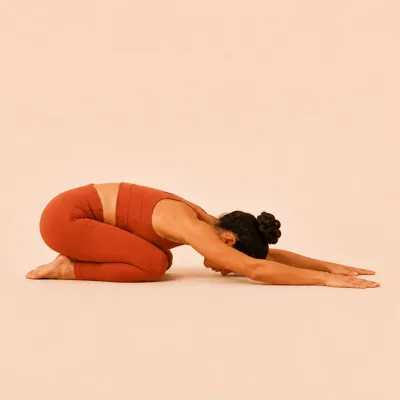
From kneeling you sit the hips back toward the heels and fold forward, resting the forehead on the floor. The arms reach forward or rest back alongside the legs, whichever is more restful. The whole body softens and the breath moves into the back of the body.
The knees can stay together or settle wide apart. Wide is the version most people find more comfortable, because it gives the belly and chest somewhere to go rather than being compressed against the thighs. If the fold feels cramped, widening the knees usually fixes it in one move.
The forehead reaching the floor is not a requirement. If it does not reach, rest it on a cushion or on stacked fists. Straining down toward the floor turns a resting pose into a stretch you are enduring.
It releases the back, hips and shoulders and quiets things down. There is nothing to achieve in it, which is the point and the part people find hardest.
How to practise it
-
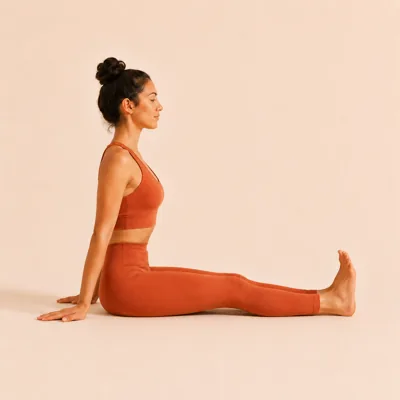
Start seated
Sit tall in a comfortable seated posture, grounding through the sit bones and lengthening the spine.
-
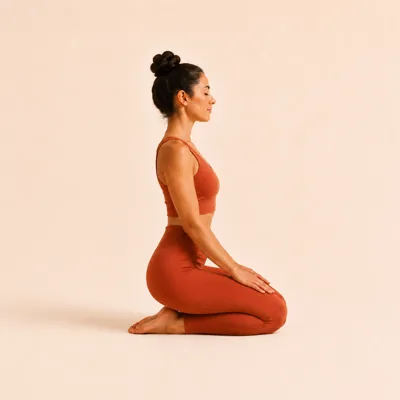
Move to Thunderbolt
Come onto the knees into Thunderbolt pose, sitting the hips back onto the heels with the spine tall. Let the knees stay together or settle wide apart, whichever is more comfortable for your hips and back.
-
Fold and rest
Sit your hips back towards your heels and fold forward, resting your forehead on the floor. Reach the arms forward, or rest them back alongside the legs, whichever feels more restful.
-
Soften and breathe
Let the whole body soften and grow heavy, and breathe slowly into the back of the body. Rest here for as long as you like.
-
Return to Thunderbolt
Rise back up into Thunderbolt pose, sitting tall on the heels.
-
Return to seated
Come back to a comfortable seated posture, sitting tall and grounded.
How long and how often
For as long as you like. It is a rest rather than a timed pose, and the app treats it that way.
It works as a pause mid-practice, as a counter-pose after backbends, and as a quiet posture in its own right. It follows Cobra, Locust and Bow particularly well.
Use cushions freely: under the forehead, between the hips and heels, or behind the knees. All three are standard.
What usually goes wrong
Straining to reach the floor with the forehead. Rest it on a cushion or stacked fists instead. Reaching for the floor keeps the neck and shoulders working in a pose whose purpose is to stop working.
Keeping the knees together when it feels cramped. Widening the knees gives the torso room and is usually the single adjustment that makes the pose restful.
Sitting with the hips well off the heels and calling it a rest. If the hips hover, the thighs are holding you up. A cushion between the hips and heels lets you actually sit down.
Holding the shoulders up around the ears. Whether the arms reach forward or rest back, the shoulders should be soft. Reaching forward actively is a stretch, not a rest.
Who should take care
Practise safely. Rest the forehead on a cushion or stacked fists if it doesn't reach the floor, and place a cushion between the hips and heels or behind the knees if that is more comfortable. Widen the knees if the belly feels compressed, and take care if you have knee issues. See our full Health & Safety Disclaimer.
Rest for as long as you like
PanchPrana walks in and out of Child's Pose through Thunderbolt, which is easier on the knees than dropping straight into it. It is one of the 66 techniques that are free to practise in full, with no account needed.


Common questions
Knees together or apart?
Either, and wide is more comfortable for most people because it gives the belly and chest room. Try wide first if the fold feels cramped.
My forehead does not reach the floor.
Rest it on a cushion or on stacked fists. There is no benefit to straining toward the ground.
My hips will not reach my heels.
Place a cushion between the hips and the heels. That lets you sit down properly instead of holding yourself up with the thighs.
Where should my arms go?
Reaching forward or resting back alongside the legs, whichever is more restful. Back alongside the legs is usually the more relaxing of the two.
How long should I stay?
As long as you like. It is a resting pose with no target duration.