On this page
Crocodile Pose is a resting posture with a teaching function attached. Lying face down with the belly against the floor means every inhale presses into the ground, which makes the movement of a low breath unmistakable. It does what the two-hand test in belly breathing does, without you having to check anything.
What it is
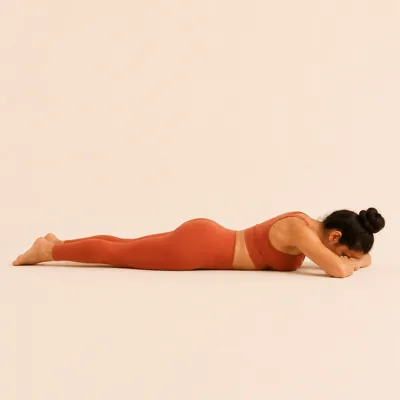
You lie on your front, fold the arms in front and rest the forehead on them, or turn one cheek to the mat, whichever lets the neck relax. The legs rest a little apart with the heels falling open and the toes turning out. Then you soften and grow heavy.
The floor gives immediate feedback. In an upright position, feeling whether the breath is low takes attention. Face down, the belly has nowhere to go but into the mat, and the sensation is obvious. People who struggle to find diaphragmatic breathing sitting up often find it here without instruction.
It is also a genuine rest, and a useful alternative to Shavasana for anyone who finds lying on their back uncomfortable. It sits well between stronger postures, particularly after the prone backbends, where it lets the back settle.
If pregnant, choose a different resting pose. Lying face down is the reason.
How to practise it
-
Lie on your front
Lie down on your front. Fold your arms in front of you and rest your forehead on them, or turn one cheek to the mat. Whichever lets the neck relax.
-
Let go completely
Let the legs rest a little apart with the heels falling open and the toes turning out. Let the whole body soften and grow heavy against the floor.
-
Rest and breathe
Breathe naturally and feel the belly press gently into the floor with each inhale. Rest here, calm and still, for a couple of minutes.
How long and how often
The app runs two minutes, which is enough to settle. Longer is fine if it is comfortable.
Use it between stronger poses, after Cobra, Locust or Bow in particular, and as a face-down alternative to final relaxation.
Place a folded blanket under the hips or chest if the lower back feels compressed. That is the standard adjustment.
What usually goes wrong
Craning the neck. The forehead rests on the folded arms, or one cheek turns to the mat. Holding the head up to look forward defeats the pose entirely.
Keeping the legs together and tense. The legs rest a little apart with the heels falling open. Held together they keep the hips and lower back engaged, which prevents the settling.
Breathing deliberately. This is a resting pose. Let the breath move on its own and simply notice it pressing into the floor rather than shaping it.
Ignoring a compressed lower back. Lying flat on the front arches the lumbar spine for some people. A folded blanket under the hips fixes it and costs nothing.
Who should take care
Practise safely. Comfortable for most people. Place a folded blanket under the hips or chest if the lower back feels compressed. If pregnant, choose a different resting pose. See our full Health & Safety Disclaimer.
Two minutes face down
PanchPrana times the rest so you can stop tracking it, and Crocodile sits naturally after the prone backbends. It is one of the 66 techniques that are free to practise in full, with no account needed.


Common questions
How is it different from Shavasana?
Shavasana is on the back; Crocodile is face down. Crocodile makes the belly breath obvious because the floor gives feedback, and it suits people who find lying on their back uncomfortable.
Where should my head go?
Forehead resting on the folded arms, or one cheek turned to the mat. Whichever lets the neck be genuinely relaxed.
My lower back feels compressed. What can I do?
Place a folded blanket under the hips, or under the chest. Either reduces the arch through the lumbar spine.
Is it safe in pregnancy?
No. The app advises choosing a different resting pose, since this one involves lying on the front.
Can I use it instead of final relaxation?
Yes. It is a legitimate face-down alternative and the app describes it that way.