On this page
Shavasana is the pose most often cut when time is short, on the reasonable-sounding grounds that lying still is not doing anything. That is precisely what it is for. The settling that happens after a practice is part of the practice, and cutting it leaves the session unfinished rather than merely shorter.
What it is
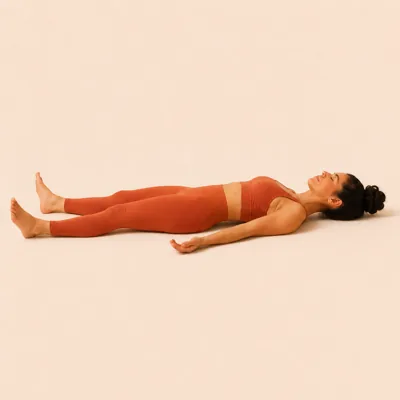
You lie flat on your back on a comfortable surface, let the feet fall open, rest the arms a little away from the body with the palms facing up, and let the floor take your full weight. Then you soften everything in turn and stop guiding the breath entirely.
Letting the breath go is the instruction that separates this from the breathing practices. Everywhere else in the library you are shaping the breath somehow. Here you stop completely and let it find its own rhythm, which is often noticeably different after a session than before one.
Coming out matters as much as going in. You deepen the breath, wiggle the fingers and toes, stretch, roll to one side and pause there before coming up to sit. Standing straight up from deep relaxation is disorientating and undoes some of what just settled.
It is safe and welcome for everyone, with adjustments: bend the knees with the feet on the floor if lying flat is uncomfortable for the back, or rest the lower legs on a cushion. If pregnant, lie on your side instead.
How to practise it
-
Lie down and settle
Lie flat on your back on a comfortable surface. Let the feet fall open, rest the arms a little away from the body with the palms facing up, and let the whole body feel supported by the floor.
-
Let go completely
Soften every part of the body in turn. The face and jaw, the shoulders, the hands, the belly, the legs. Release any effort to hold or arrange yourself, and let the floor take your full weight.
-
Let the breath be free
Stop guiding the breath entirely. Let it move on its own, in its own rhythm. Simply rest here, aware but at ease, for a few minutes.
-
Come back gently
When you are ready, deepen the breath, wiggle the fingers and toes, and stretch. Roll to one side and pause before slowly coming up to sit, carrying the calm with you.
How long and how often
The app runs three minutes, which is a realistic length. Five to ten is a fuller version if you have the time.
It belongs at the end of a movement or breathing session, and it is where a sun salutation practice finishes. It also works on its own as a short rest.
Keep warm. Body temperature drops when you lie still, and being cold is the most common reason people cannot settle.
What usually goes wrong
Skipping it. It is as much part of the practice as the movement, which is what the app says directly. A session that ends the moment the last pose finishes is missing its settling.
Continuing to control the breath. The instruction is to stop guiding it entirely. Carrying a count into Shavasana keeps a part of you working.
Getting up quickly. Deepen the breath, move the fingers and toes, roll to one side and pause before sitting up. Standing straight up is disorientating.
Lying flat when it hurts. Bend the knees with the feet on the floor, or put a cushion under the lower legs. A flat back that aches will occupy all your attention.
Who should take care
Practise safely. Safe and welcome for everyone. If lying flat is uncomfortable for your back, bend the knees with the feet on the floor, or rest the lower legs on a cushion. If pregnant, lie on your side instead. Keep warm. The body cools as it relaxes. See our full Health & Safety Disclaimer.
Three minutes, timed
The reason Shavasana gets cut is that nobody wants to lie there wondering how long it has been. PanchPrana times it and brings you out gently. It is one of the 66 techniques that are free to practise in full, with no account needed.


Common questions
How long should I stay?
Three minutes is a good working length and what the app runs. Five to ten minutes is a fuller version when there is time.
My lower back hurts lying flat. What can I do?
Bend the knees with the feet flat on the floor, or rest the lower legs on a cushion or bolster. Both take the load off the lumbar spine.
Is it safe in pregnancy?
The app advises lying on your side instead. Side-lying with support is the usual alternative.
What if I fall asleep?
It happens and is not a problem, though the intention is to be aware and at ease rather than asleep. If it happens every time, try it earlier in the day or with the eyes slightly open.
Should I control my breath?
No. This is the one practice where you stop guiding the breath entirely and let it move on its own.