On this page
Locust is the counterweight to a life spent folding forward. It is one of the few poses in the library that strengthens rather than stretches, and the version taught here keeps the chest and chin on the mat while only the legs lift, which concentrates the work where it is wanted.
What it is
You lie on your front with the legs together and the arms alongside the body, palms down, and the chin resting lightly on the mat. On an inhale you lift both legs away from the floor, reaching back through the toes, while the chest, chin and arms stay resting.
Keeping the upper body down is what makes this a specific exercise rather than a general one. The lift is produced by the muscles along the spine and the glutes, and leaving the chest on the mat means nothing else can help.
The neck stays long with the gaze down. It is easy to lift the chin as effort increases, and that compresses the back of the neck for no benefit.
It is energising and a direct counter to sitting and forward-folding, which is why it often appears after seated work.
How to practise it
-
Lie on your front
Lie on your front with the legs together and the arms alongside the body, palms down. Rest the chin lightly on the mat.
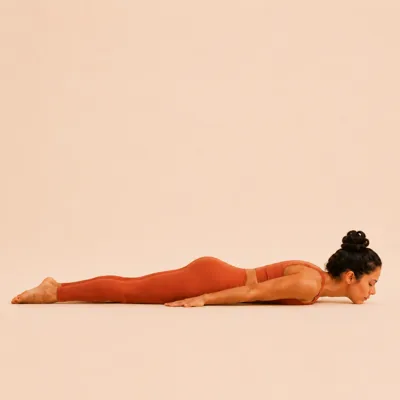
-
Lift the legs
Breathe in and lift both legs away from the floor, reaching back through the toes. Keep the chest, chin and arms resting on the mat. Lift only as high as feels comfortable.
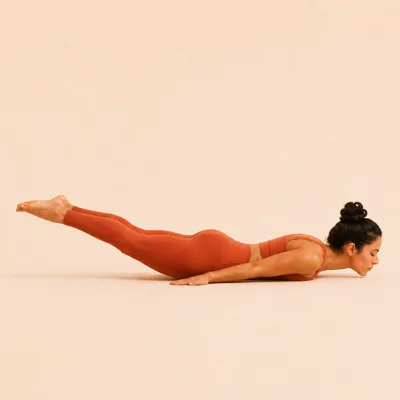
-
Come back to Prone
Exhale and gently lower the legs back down to the mat, returning to lying flat on your front.
How long and how often
A few slow breaths in the lift, then lower on an exhale. Two or three repetitions is a reasonable practice.
Lift only as high as feels easy, which for many people is a few centimetres. Height is not the point; the sustained engagement of the back is.
Rest afterwards. Crocodile Pose or Child's Pose both suit it well as a counter.
What usually goes wrong
Wrenching the legs up. The lift is led by the back and glutes, not thrown. A small controlled lift beats a high snatched one.
Lifting the chin. The neck stays long with the gaze down, which the app says explicitly to protect it. The chin tends to rise as the legs get heavier.
Pushing into a pinching lower back. A pinch means the lift is too high or the glutes are not engaging. Lower the legs and try a smaller range.
Bending the knees to get higher. Reaching back through the toes with straight legs is the shape. Bending the knees raises the feet without doing the work.
Who should take care
Practise safely. Keep the lift small and led by the back and glute muscles, never by wrenching. Keep the neck long and the gaze down to protect it. Ease off if the lower back pinches, and take care if you are pregnant or have back issues. See our full Health & Safety Disclaimer.
A small lift, held steadily
PanchPrana keeps the cue on lifting from the back rather than reaching for height, which is what makes this pose worth doing. It is one of the 66 techniques that are free to practise in full, with no account needed.


Common questions
How high should my legs go?
Only as high as feels comfortable, which is often not very high. The engagement matters more than the height.
Should my chest lift too?
Not in this version. The app teaches it with the chest, chin and arms resting so the work stays in the back and legs. Fuller variations that lift the chest exist and are stronger.
Why does my lower back pinch?
Usually lifting too high, or the glutes not engaging so the lumbar spine takes the load. Go lower and squeeze the glutes as you lift.
Where should I look?
Down, with the neck long. Lifting the chin compresses the back of the neck.
Who should take care?
The app advises care in pregnancy, and this pose involves lying on the front, which rules it out later on. Ease off if the lower back pinches.