On this page
The tension across the shoulders and upper back from sitting at a screen has a habit of becoming invisible. It builds slowly enough that the raised, forward position starts to feel like your neutral. This sequence is three simple movements that put the shoulder blades through their range and make the difference obvious again.
What it is
The sequence is shrugs, rolls and rotations. Shrugs lift the shoulders toward the ears on an inhale and let them drop completely on the exhale. Rolls circle them forward and then backward. Rotations take them through full, slow circles in each direction.
The drop at the end of a shrug is the part that does the work. Deliberately raising the shoulders and then releasing them tends to produce a lower resting position than simply trying to relax them, because you cannot release something you were not aware of holding. The lift is there to make the drop possible.
The rolls and rotations then move the shoulder blades across the ribcage, which is the movement that sitting removes. What people commonly report is that the upper back feels looser and the head sits further back afterwards. That is the scale of it; nothing here treats a shoulder injury.
How to practise it
-
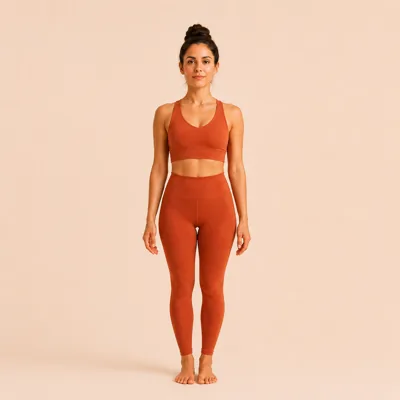
Stand or sit tall
You can do these standing or sitting. Pick whichever is comfortable. Let the spine rise gently tall, the arms hang relaxed by your sides, and the face and jaw soften. Take a steady breath before you begin.
-
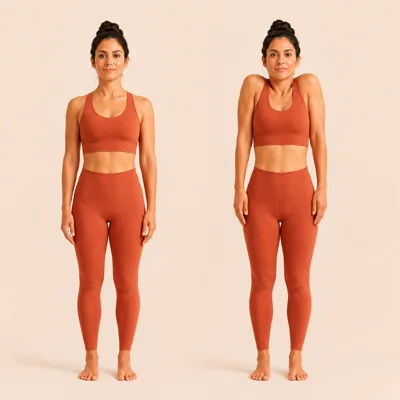
Shoulder shrugs
Breathe in and lift both shoulders up towards your ears, then breathe out and let them drop completely, releasing the tension. Repeat slowly for three rounds.
-
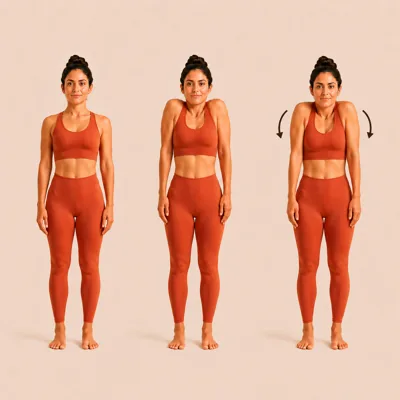
Shoulder rolls
Roll both shoulders slowly forwards in smooth circles for three rounds, then reverse and roll them backwards for three rounds. Let the movement stay easy and unhurried.
-
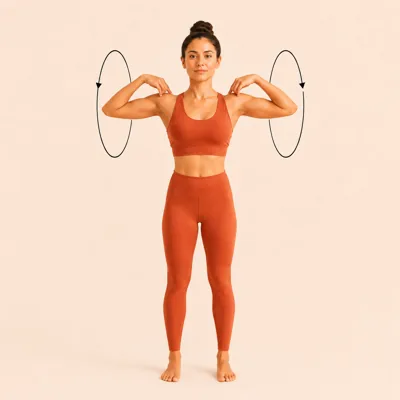
Shoulder rotations
Circle the shoulders in full, slow rotations. Clockwise for three rounds, then counterclockwise for three rounds. Feel the shoulder blades move freely.
How long and how often
Three rounds of each movement, standing or seated, which takes two or three minutes. Roll forward three times and backward three times rather than only one direction.
This is a sequence to do often and briefly. It suits a break in a working day, the start of a yoga practice, and the few minutes before sitting down to breathe, where held shoulder tension makes an upright seat uncomfortable.
There is nothing to build. The movements do not get larger or longer with practice.
What usually goes wrong
Lowering the shoulders slowly after a shrug. The release is meant to be a drop, not a controlled lowering. Letting them fall on the exhale is what produces the sense of release; easing them down keeps the muscles engaged throughout.
Only rolling one way. Forward rolls and backward rolls do different things, and backward is the one that counteracts a desk posture. Doing three of each is the point.
Rushing. These are small movements and speeding them up turns them into a shake. Slow and unhurried is what lets the shoulder blades actually travel.
Pushing through a pinch. Something catching at the top of a rotation is a signal to make the circle smaller, not to work through it.
Who should take care
Practise safely. Keep every movement slow and within a comfortable range. Ease off if anything pinches, and keep the circles smaller if the shoulders feel stiff. Stop if you feel any sharp pain. See our full Health & Safety Disclaimer.
Three movements, counted
PanchPrana runs the shrugs, rolls and rotations in order with the rounds counted, so the pace stays slow and the backward direction does not get skipped. It is one of the 66 techniques that are free to practise in full.


Common questions
How is a roll different from a rotation?
A roll is a smaller circular movement of the shoulders themselves. A rotation is a fuller circle that lets the shoulder blades move more freely across the back. The app runs both because they cover different amounts of range.
Should I breathe with the shrugs?
Yes. Inhale as the shoulders lift, exhale as they drop. The exhale is what makes the release complete.
Can I do this at a desk?
Yes, and it is one of the practices most worth doing there. Seated works as well as standing as long as the spine is tall.
My shoulders click when I rotate them. Is that bad?
Painless clicking is common. If a movement is painful, or catches sharply, keep the circles small and have it looked at rather than working through it.
How often should I do it?
As often as you notice the tension. Short and frequent beats long and occasional for desk-related stiffness.