On this page
The standing twist looks like the most casual movement in the library and has one strict requirement inside it. The turn comes from the waist and spine, and the arms swing loosely as a consequence. The moment the arms start pulling the torso round, the movement becomes a wrench rather than a mobilisation.
What it is
You stand with the feet about hip-width apart and the knees soft, arms hanging loose, and turn gently to the left and then to the right, letting the arms swing around the body. The hips stay facing forward. Three rounds each side, slowly and rhythmically.
Keeping the hips forward is what makes it a spinal movement. If the pelvis rotates with the chest, the spine has hardly twisted at all and you have simply turned on the spot. The contrast between a fixed pelvis and a turning ribcage is where the rotation lives.
It relieves the stiffness that builds across the back and waist from sitting, and it is a reasonable preparation for the seated twists, which take the same rotation further and hold it.
How to practise it
-
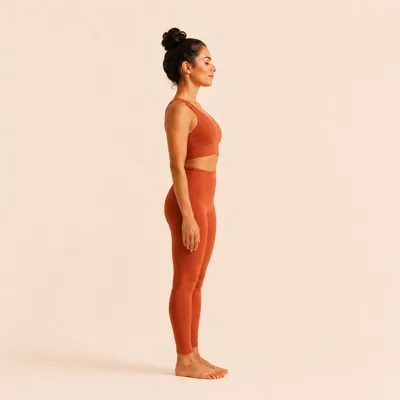
Stand tall
Stand tall with the feet about hip-width apart and the knees soft. Let the arms hang loose and relaxed.
-
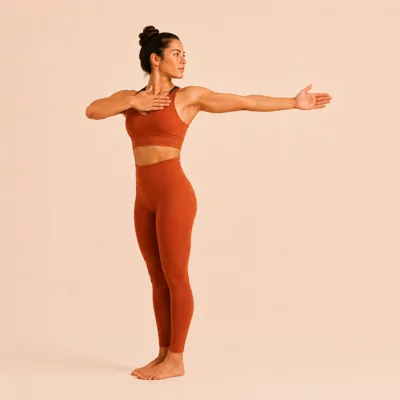
Twist side to side
Turn gently to the left, letting the arms swing loosely around the body, then turn to the right. Keep the hips facing forward and let the twist come from the spine. Alternate slowly for three rounds each side.
How long and how often
Three rounds each side, alternating slowly, which takes a minute or two.
It suits a warm-up, a break from sitting, and a wind-down after standing work. With the standing side bend and back bend it makes a short three-part sequence covering rotation, lateral bending and extension.
Keep the range small if you have any back issues, which is what the app advises.
What usually goes wrong
Yanking with the arms. The arms are passengers. Using them to whip the torso further round loads the lower back at the end of the range and is the main way people hurt themselves in this movement.
Turning the hips. If the pelvis rotates too, the spine barely twists. Keep the hips facing forward and let the turn happen above them.
Going fast. Momentum plus rotation plus a fixed pelvis is not a combination worth rushing. Slow and rhythmic.
Locking the knees. Soft knees let the movement stay in the spine. Straight locked legs push it into the lower back and the knees themselves.
Who should take care
Practise safely. Keep the twist gentle and led by the waist, not forced by the arms. Go slowly and keep the range small if you have any back issues. See our full Health & Safety Disclaimer.
Three rounds each way
PanchPrana paces the twist so it stays slow enough for the arms to swing rather than pull. It is one of the 66 techniques that are free to practise in full, with no account needed.


Common questions
Should my hips turn with me?
No. Keeping the hips facing forward is what puts the rotation into the spine. If the pelvis turns, you are rotating at the feet rather than through the back.
How far should I twist?
Only as far as the waist takes you comfortably. Keep the range small if you have any back issues, and never let the arms drag you further.
Why are the arms loose?
So they cannot pull. A loose arm swings to wherever the torso takes it, which keeps the movement honest and the end range safe.
Can I do it seated?
A seated version exists but is a different movement, since the pelvis is already fixed. The half spinal twist is the seated equivalent worth learning.
Is this a good warm-up for seated twists?
Yes. It takes the same rotation through a smaller range without holding it, which is a sensible preparation.