On this page
Every seated twist works on the same principle and fails in the same way. The principle is that you lengthen the spine first and then rotate within that length. The failure is using the arm to crank yourself further round, which compresses the spine rather than wringing it out and puts the whole twist into the neck and lower back.
What it is
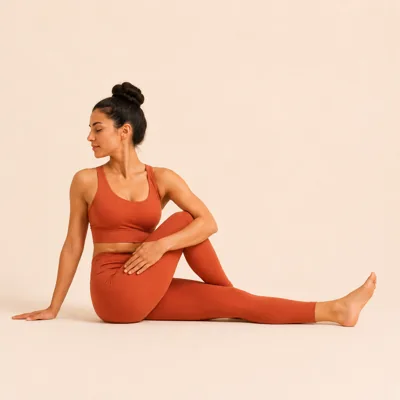
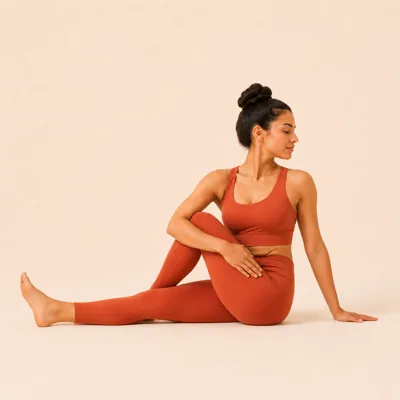
From sitting tall with both legs extended, you bend one knee and cross that foot over the opposite leg, planting the sole beside the knee. The hand on the same side as the bent leg plants on the floor behind you, and the opposite arm comes across against the outside of the bent knee as a lever. You then turn toward the bent leg.
The order matters: lengthen, then turn. Inhale to lengthen up through the spine, exhale to turn a little further. A twist taken on a compressed spine has nowhere to go and ends up happening at the two most mobile points, the neck and the lumbar spine, which is where people feel it afterwards.
The arm is a gentle lever, not a winch. It provides a point of resistance against the knee that lets the torso rotate. Using it to haul yourself round past what the spine will do is the fault the whole pose turns on.
Both sitting bones stay grounded. If one lifts, the pelvis has turned with you and the spine has stopped twisting.
How to practise it
-
Staff Pose
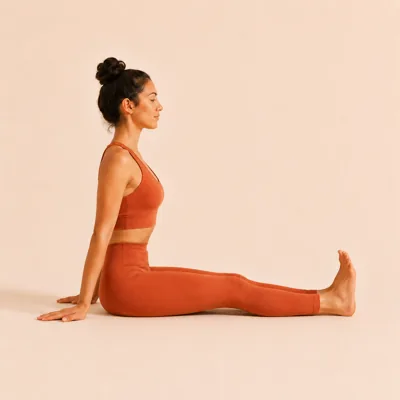
Sit tall with both legs extended in front of you, spine long, hands resting lightly beside the hips. Ground both sitting bones evenly and lift up through the crown of the head.
-
Twist to the left
Bend the right knee and cross the right foot over the left leg, planting the sole on the floor beside the left knee. Plant the right hand on the floor behind you and bring the left arm across the outside of the left knee. Inhale to lengthen the spine, exhale and turn gently to the left, letting the gaze follow last.
-
Release to Staff Pose
Inhale to lengthen, then slowly unwind the twist. Release the leg and return to sitting tall with both legs extended, spine long and neutral.
-
Twist to the right
Bend the left knee and cross the left foot over the right leg, planting the sole on the floor beside the right knee. Plant the left hand on the floor behind you and bring the right arm across the outside of the right knee. Inhale to lengthen the spine, exhale and turn gently to the right, letting the gaze follow last.
-
Release to Staff Pose
Inhale to lengthen, then slowly unwind the twist. Release the leg and return to sitting tall with both legs extended, spine long and neutral.
How long and how often
Hold each side for several steady breaths, using the inhale to lengthen and the exhale to deepen slightly. Then unwind slowly and repeat on the other side.
Always work both sides evenly. This is easier to remember here than in most poses because the shape is so obviously one-sided.
Sit up on a cushion if the lower back rounds. The same adjustment that fixes Staff Pose fixes this one.
What usually goes wrong
Twisting from the neck. Turning the head round while the torso stays put looks like a deeper twist and is not one. The rotation comes from the base of the spine upward, and the head goes last.
Cranking with the arm. The arm is a gentle lever. Hauling on the knee forces rotation the spine has not produced and compresses it.
Letting a sitting bone lift. Both stay grounded. A lifted sitting bone means the pelvis has turned along with the torso, which cancels out the twist.
Collapsing the spine as you turn. Length is lost quickly during a twist. Re-lengthen on every inhale rather than settling into the shape and rounding.
Who should take care
Practise safely. Keep both sitting bones grounded and the spine long rather than twisting from the neck alone. Sit up on a cushion if the lower back rounds. Keep the twist gentle if you have back or disc issues, and ease off if anything pinches. See our full Health & Safety Disclaimer.
Both sides, evenly
PanchPrana returns to Staff Pose between the two sides, which resets the spine and makes it much harder to give one side more than the other. It is one of the 66 techniques that are free to practise in full, with no account needed.


Common questions
Should I twist from the neck?
No. The rotation starts at the base of the spine and works upward, with the head turning last and only as far as the torso has gone.
Why does my lower back round?
Tight hamstrings tipping the pelvis backward, usually. Sit up on a cushion and the spine will lengthen, which makes the twist work properly.
How hard should I push with my arm?
Gently. The arm is a lever giving you something to rotate against, not a tool for forcing more range.
Which way do I turn?
Toward the bent leg. If the right foot is crossed over, you twist to the right.
Who should take care?
The app says to keep the twist gentle if you have back or disc issues. Twisting is a movement where forcing has a poor risk-to-benefit ratio.