On this page
Triangle breathing is box breathing with one side removed. You inhale for four, hold for four, exhale for four, and then begin the next inhale straight away with no pause at the bottom. That single missing hold changes the character of the practice more than the small difference on paper suggests.
What it is
The three sides are the inhale, the retention after it, and the exhale. All three are the same length. The absence of a fourth side means the cycle turns over continuously, which is why it feels more like breathing and less like a pattern of held positions.
Holding after the inhale and holding after the exhale are not equivalent experiences. A hold on a full breath is comfortable for most people. A hold on an empty one creates air hunger much sooner, and it is the part of box breathing that beginners find difficult. Triangle breathing keeps the easier retention and drops the harder one.
That makes it the sensible step between equal breathing, which has no holds at all, and box breathing, which has two. The tradition places retention at the centre of pranayama and treats it as something introduced gradually. What people commonly report here is steadier attention without the slight strain box breathing can carry early on.
How to practise it
-
Sit comfortably
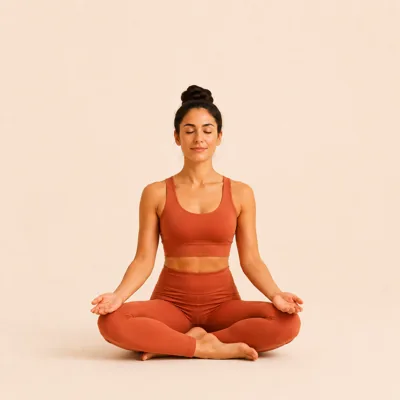
Choose any steady seated posture. Cross-legged on the floor, or feet flat on the floor in a chair. Let the shoulders drop and the spine rise gently tall.
-
Inhale
Inhale smoothly through the nose for a count of four, letting the belly and ribs expand. This is the triangle's first side.
-
Hold the breath in
Keep the breath in for a gentle count of four. The second side. Stay soft in the face and shoulders; there is no need to grip.
-
Exhale
Release the breath slowly for four counts, the third side, then begin the next inhale straight away. Keep every side the same length and unforced.
How long and how often
The app runs eight rounds at four counts a side, which is about two and a half minutes. Twelve counts to a round makes this slower than it looks written down.
Lengthen all three sides together when four is easy, to five and then six. Do not lengthen the hold alone: keeping the sides equal is what the practice is. If any side feels tight, go back a count.
Practise it on a reasonably empty stomach, as with anything involving retention, and sit upright rather than lying down. It suits the working day, before something requiring concentration, more than it suits bedtime.
What usually goes wrong
Gripping the throat during the hold. The retention is a pause with the breath already in, not a breath sealed in under pressure. The face, jaw and shoulders should stay soft throughout. If they cannot, the hold is too long.
Adding a pause at the bottom. The next inhale begins as soon as the exhale finishes. A pause creeping in at the bottom means you are drifting into box breathing, which is fine as a choice but not as an accident.
Taking a big inhale to survive the hold. Over-filling makes the retention harder, not easier, and it brings the shoulders up. Keep the inhale ordinary and shorten the count instead.
Keeping a count that has stopped being comfortable. Retention is the part of any practice where pushing through is a genuinely bad idea. Shorten it, or leave the hold out and practise equal breathing until it settles.
Who should take care
Practise safely. Keep the hold gentle and never strain. If the hold feels tight or you feel breathless, shorten it or leave it out. Ease off and breathe naturally if you feel lightheaded. See our full Health & Safety Disclaimer.
Eight rounds, three sides, counted
Counting a three-phase cycle while keeping a retention soft is more than most people want to hold in their head. PanchPrana cues each side aloud, and triangle breathing is one of the 66 techniques that are free to practise in full, with no account needed.


Common questions
How is triangle breathing different from box breathing?
Box breathing has four equal phases: inhale, hold, exhale, hold. Triangle breathing drops the last one, so the next inhale follows the exhale immediately. Fewer retentions makes it the gentler of the two.
Should I hold after the inhale or after the exhale?
After the inhale. That is the second side of the triangle. A hold on an empty breath is the fourth side of the box, and it is deliberately not part of this practice.
What if the hold feels tight?
Shorten it, or leave it out entirely and practise equal breathing instead. There is no value in a strained retention, and the app gives the same instruction.
Who should avoid the hold?
Retention does not suit everyone. If you are pregnant, or manage low blood pressure, a heart, lung or seizure condition, keep holds short or leave them out and check with a doctor first.
Can I lengthen just the hold?
Not in this practice. The three sides are meant to stay equal, so lengthen all of them together or none of them. Isolating a long retention is a different and more advanced practice.