On this page
Ujayi is the breath used through most of a flowing yoga practice, and it is the one most often learned by imitation from the person on the next mat. That tends to produce a loud rasp made in the wrong place. The constriction is slight and it sits at the glottis, and there is a reliable way to find it that does not involve guessing.
What it is
Ujayi, often spelled Ujjayi and translated as victorious breath or ocean breath, is made by narrowing the back of the throat slightly so that the breath makes a soft, steady whisper on the way in and on the way out. The mouth stays closed and the breathing is entirely nasal.
The narrowing does two things. It slows the breath mechanically, in the same way pursed lips do at the other end, so a long even breath takes less discipline to maintain. And it gives you a sound to follow, which is why it holds attention through a moving practice where watching the breath alone would be difficult.
The way to find it is with the mouth open. Exhale slowly as though fogging a mirror and notice the soft hiss at the back of the throat. That is the whole technique. Then keep exactly that shape, close the mouth, and breathe through the nose instead. The breath now catches on the throat rather than on the lips.
The tradition treats it as a warming, steadying breath and the default for asana practice. What people commonly report is that it makes a long practice easier to stay with. Claims about the sound itself doing anything physiological beyond slowing the breath would need evidence and are not made here.
How to practise it
-
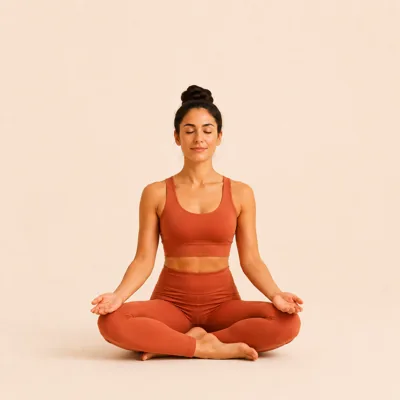
Sit comfortably
Settle into a comfortable seated posture with a tall, easy spine, and let the shoulders and face soften.
-
Find the sound
First, feel the throat narrow: open your mouth and exhale slowly as if fogging up a mirror, and notice the soft hissing at the back of the throat. That gentle squeeze at the glottis is the whole technique.
-
Now do it with the mouth closed
Keep that same slight constriction at the back of the throat, but close your mouth and breathe only through the nose. As if you were about to whisper, but with the lips sealed. The breath now drags softly against the throat instead of the lips.
-
Breathe in and out through the throat
Inhale slowly through the nose, feeling the breath catch against the back of the throat as it fills the belly and then the chest. Then exhale slowly through the nose, holding the same throat constriction so the out-breath makes a soft hissing, whooshing sound. Both the inhale and the exhale carry the sound.
-
Keep it smooth and even
Aim for an even, unhurried rhythm. The inhale and exhale about the same length. The sound should be audible to someone sitting beside you, but never forced, strained, or rasping. Let it stay soft and steady, like waves.
How long and how often
The app runs ten rounds seated, which is a couple of minutes and enough to establish the sound. Seated practice is where the technique is learned.
The real use is longer and elsewhere. Once the constriction is reliable, Ujayi becomes the breath you hold through a movement practice, for as long as that practice lasts. There is no round count in that context.
Keep the inhale and exhale about the same length. This is not a ratio practice, and adding a longer exhale on top of the constriction tends to make the sound uneven.
What usually goes wrong
Making it loud. It should be audible to someone sitting beside you and no more. A sound that carries across a room is being made with force rather than with a light narrowing, and it will leave the throat sore.
Making the sound in the nose. A nasal snore is a different sound produced in a different place. The constriction is at the glottis, at the back of the throat, which is why finding it with the mouth open first matters.
Only doing it on the exhale. Both halves carry the sound. The inhale version is harder to find and is usually the one that gets dropped, which leaves the breath uneven.
Pushing through a scratchy throat. Scratchiness means the squeeze is too hard. Soften it until the sound is barely there and build back up. There is nothing to be gained from a forced constriction.
Who should take care
Practise safely. Breathe through the nose throughout, mouth closed. If the throat feels tight or scratchy, soften the effort. The constriction is slight, not a squeeze. Ease off if you feel lightheaded and return to natural breathing. See our full Health & Safety Disclaimer.
Ten rounds to find the sound
PanchPrana walks through the mouth-open step first, which is the part most instructions skip and the reason Ujayi is so often learned wrong. It is one of the 66 techniques that are free to practise in full, with no account needed.


Common questions
Is it Ujayi or Ujjayi?
Both spellings are common for the same practice. The app uses Ujayi; Ujjayi is the more frequent spelling elsewhere, and ocean breath or victorious breath in English.
How loud should it be?
Soft enough to be a whisper and audible to someone next to you. If it is loud enough to be heard across a room, ease the constriction off.
Do I breathe through my mouth?
Only when learning the sound. The mouth-open exhale is a way to locate the constriction; the practice itself is entirely nasal with the lips closed.
Should the inhale and exhale be equal?
Yes, roughly. Ujayi is an even breath rather than a ratio practice. If you want a longer out-breath, extended exhale is the practice for that.
Can I use it during yoga?
That is its main use. It is the breath carried through much of a flowing practice, which is why it is worth establishing seated first, where you can hear what you are doing.